

Aconcagua: The Ultimate Guide to Climbing the Highest Mountain in the Americas
Discover Aconcagua: South America’s Highest and Most Iconic Summit
Tue 9 Dec 2025
Aconcagua: The Ultimate Guide to Climbing the Highest Mountain in the Americas
Climb Aconcagua with KooKoo Climb. Check all the info and details HERE
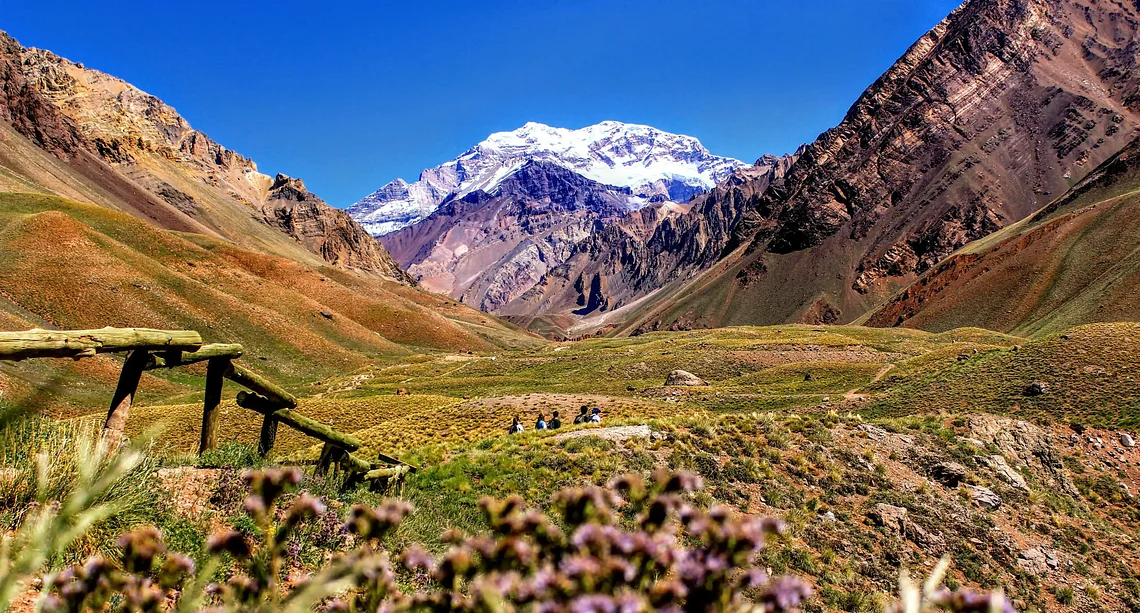
With its monumental height of 6,962 meters (22,838 ft), Aconcagua dominates the Andes as the tallest peak in South America, the highest mountain in the Western Hemisphere, and the most elevated summit on Earth outside the Himalaya–Karakoram ranges. Towering over Argentina’s rugged skyline, it has become a symbolic landmark of the Andes and an essential objective for mountaineers pursuing the Seven Summits challenge. Its enormous ridges, sweeping valleys of rock and ice, and nearby glaciers give Aconcagua an almost otherworldly presence, making it a dream destination for anyone fascinated by extreme-altitude adventure.
Located in the heart of Aconcagua Provincial Park, the mountain rises above one of the driest, starkest environments in the range. Climbers typically begin their journey in Mendoza, a vibrant city known for its wine, culture, and mountaineering tradition. From there, expeditions travel toward the Vacas or Horcones Valleys, where the immensity of the Andes becomes immediately palpable. Every season, hundreds of international climbers arrive with the hope of reaching the summit of what is often called the “Roof of the Americas.” For many, standing atop Aconcagua is not only a physical achievement but also a deeply personal milestone, one of the world’s great high-altitude experiences accessible without technical climbing skills.
Yet despite its reputation as a non-technical 6,000-meter peak, Aconcagua demands far more than basic trekking ability. The Normal Route, the most commonly used path to the top, presents a combination of challenges that should never be underestimated. The mountain’s sheer altitude exposes climbers to dramatically reduced oxygen levels, forcing the body to adapt through a carefully structured acclimatization schedule. Proper pacing, hydration, sensible ascent profiles, and rest days are absolutely essential for success. Most expeditions. like ours, incorporate rotations between base camps and higher camps, allowing climbers to condition their bodies to altitude before committing to a summit attempt.
The weather on Aconcagua is another obstacle. The mountain is notorious for its brutal winds, sometimes exceeding 100 km/h (62 mph), and for sudden, rapid changes in temperature that can turn a clear morning into a whiteout within hours. Even on sunny days, the thin atmosphere and high wind chill can create extreme conditions: frostbite, dehydration, and hypothermia remain genuine risks. Long carries between camps, heavy packs, and multi-hour summit pushes require exceptional physical fitness and strong mental resilience. Climbers must be prepared for days of cold isolation, thin air, and the psychological rigidity needed to endure an environment where comfort is minimal and safety depends on discipline.
Logistically, an Aconcagua expedition demands attention to detail: securing permits, organizing gear, planning food and fuel, coordinating mule support, setting up high camps, and managing medical considerations such as altitude sickness. Even for experienced mountaineers, the mountain’s scale requires a thoughtful, systematic approach. Success often hinges on patience and respect, knowing when to push forward, when to retreat, and how to make prudent decisions in an unforgiving environment.
In essence, Aconcagua represents much more than just a climb. It is a test of endurance, a lesson in high-altitude strategy, and a powerful encounter with the forces of nature. Its beauty and magnitude draw thousands each year, but only those who prepare carefully and move with humility truly understand what the mountain demands. For those who stand on its summit, the experience is unforgettable: the vast Andes stretching endlessly in every direction, the thin air shimmering in the sunlight, and the profound sense of achievement that comes from conquering one of the world’s greatest non-technical high-altitude ascents.
The Mountain: A High-Altitude Giant of the Andes
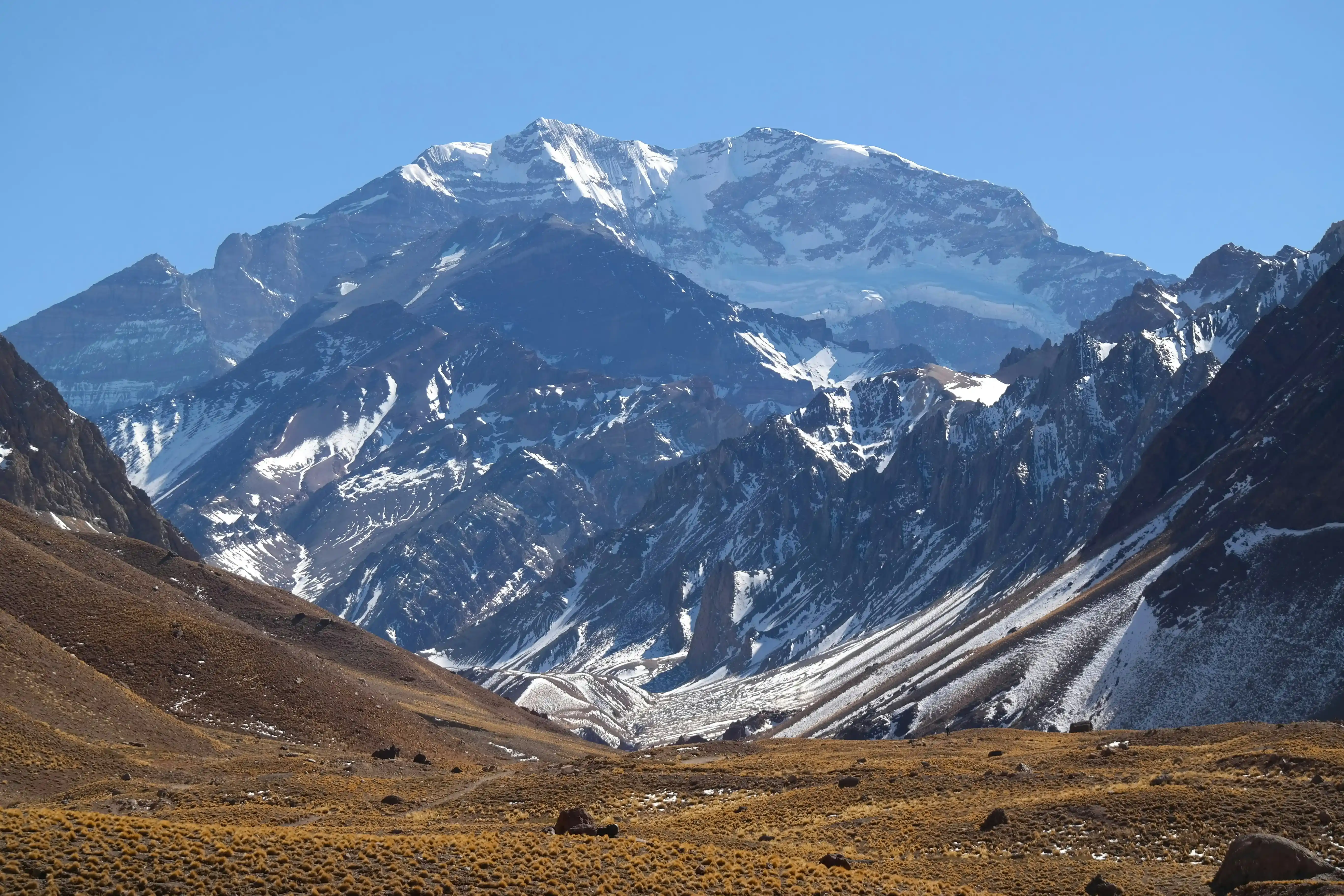
Aconcagua rises from the heart of the Central Andes, inside the protected boundaries of Aconcagua Provincial Park, just a few kilometers from the international border that separates Argentina from Chile. This region is one of the most visually striking areas in the entire mountain chain. A harsh, majestic world shaped by tectonic uplift, ancient glaciers, volcanic activity, and millions of years of erosion. The mountain towers over an already dramatic landscape filled with serrated ridgelines, massive glaciated peaks, deep U-shaped valleys, multicolored volcanic rock walls, and the high-desert expanses typical of the Andean cordillera. Seen from any angle, Aconcagua appears colossal, its huge flanks dominating the skyline and dwarfing the surrounding summits.
Because of its enormous size, the mountain exerts a powerful influence on local weather. Aconcagua generates its own micro-climates, often completely different from the conditions in the lower valleys, the nearby Chilean foothills, or even other peaks of comparable height. Climbers quickly learn that weather forecasts only tell part of the story: the upper mountain is a world of its own. Sudden temperature drops, dense cloud build-ups, and rapid pressure changes can create violent storms with little warning. The high-altitude slopes are infamous for ferocious winds, locally known as viento blanco, that can exceed 80–100 km/h, sometimes much more. These winds sweep across the exposed ridges, producing wind chills far below zero and turning otherwise manageable days into dangerous whiteouts. Even during the best part of the climbing season, the summit can remain unreachable for days or weeks due to extreme conditions.
For mountaineers, Aconcagua offers a rare and compelling combination: the chance to stand nearly 7,000 meters above sea level without the technical ice climbing, crevasse navigation, or fixed-rope ascents typical of Himalayan expeditions. This makes it one of the most desirable objectives for climbers building high-altitude experience or pursuing larger goals such as the Seven Summits. Yet to call Aconcagua “non-technical” can be misleading. While the Normal Route doesn't require advanced climbing skills, the ascent is still an expedition of high consequence, where success depends on smart acclimisation, physical preparedness, and the ability to make calm decisions in an environment where oxygen is scarce and the weather unforgiving.
The Central Andes themselves enhance the sense of adventure. This region is vast, remote, and sparsely populated, with long approaches through barren valleys that feel almost lunar in their isolation. The silence is immense, broken only by the wind, the crunch of scree underfoot, and the movement of meltwater streams descending from the glaciers. For many climbers, trekking through these wild landscapes is as memorable as the summit itself, an immersion into one of the most powerful mountain environments on Earth.
Although Aconcagua lacks the towering icefalls, serac walls, and deep crevasses of the Himalayas or Karakoram, it demands an equal measure of respect. Its altitude alone pushes the human body toward its limits, and its volatile weather patterns amplify every challenge. The mountain’s beauty is undeniable, but so is its toughness. Those who step onto its slopes must be prepared for long days at altitude, harsh exposure, and the unpredictable forces of the high Andes.
For climbers who embrace these realities, Aconcagua offers an extraordinary journey, one that blends high-altitude ambition with the raw grandeur of the Andes, delivering an experience that is physically demanding, mentally transformative, and deeply unforgettable.
High altitude Aconcagua camp
The Normal Route: A Long Journey Through the Horcones Valley
The Normal Route on Aconcagua is the classic way to the summit and the most frequently climbed line on the mountain. It follows a long, gradual progression through the Horcones Valley, a vast and arid Andean corridor surrounded by towering rock walls, glaciers, and the characteristic penitentes, which are tall, blade-shaped ice formations sculpted by the sun and wind.
The journey begins at the Horcones Valley trailhead, located at approximately 2,900 meters. From here, climbers walk through an open, desert-like landscape where the thin air becomes noticeable almost immediately. After the first day, the trail leads to Confluencia Base Camp at 3,400 meters, a vital acclimatization stop. The environment here is already harsh, with strong sun exposure during the day and cold temperatures at night, preparing climbers for the challenges ahead.
From Confluencia, the path continues deeper into the Horcones Valley toward Plaza de Mulas at 4,300 meters, the main Base Camp on Aconcagua and one of the largest high-altitude camps in the world. Approaching Plaza de Mulas is often one of the longest and most exhausting days of the entire expedition, crossing the vast high-mountain plateau known as Playa Ancha before ascending the demanding, steep section known as Cuesta Brava. Upon arriving at Base Camp, climbers encounter a small mountain city: tents, dining domes, base-camp medical stations, weather communication hubs, gear storage tents, and the support infrastructure needed to sustain hundreds of climbers during the climbing season.
Above Base Camp, the real high-altitude journey begins. The Normal Route ascends through three classic high camps:
Camp I (Canadá – 5,050 m)
A rocky terrace with sweeping views of the valley. Climbers often perform acclimatisation carries to this altitude before moving up permanently.
Camp II (Nido de Cóndores – 5,560 m)
Named “Condors’ Nest,” this camp provides breathtaking views of the Andes. It is one of the most strategic locations on the Normal Route and often used for long acclimatization days due to its relative protection and access to small water ponds in warm seasons.
Camp III (Cólera/Berlín – 5,970 m)
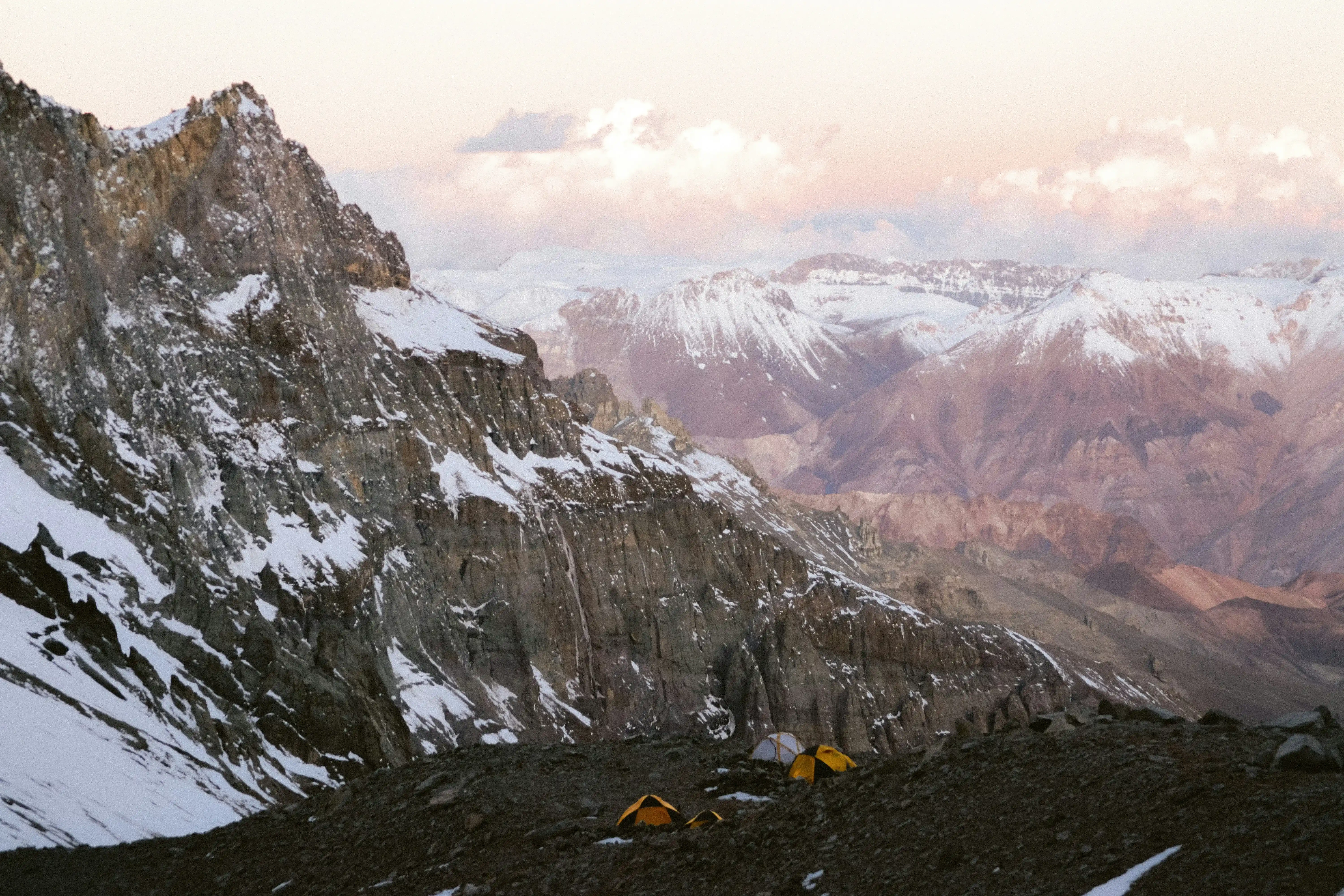
The final high camp lies on an exposed ridge just below 6,000 m. Windy, cold, and austere, this camp is the launch point for summit attempts.
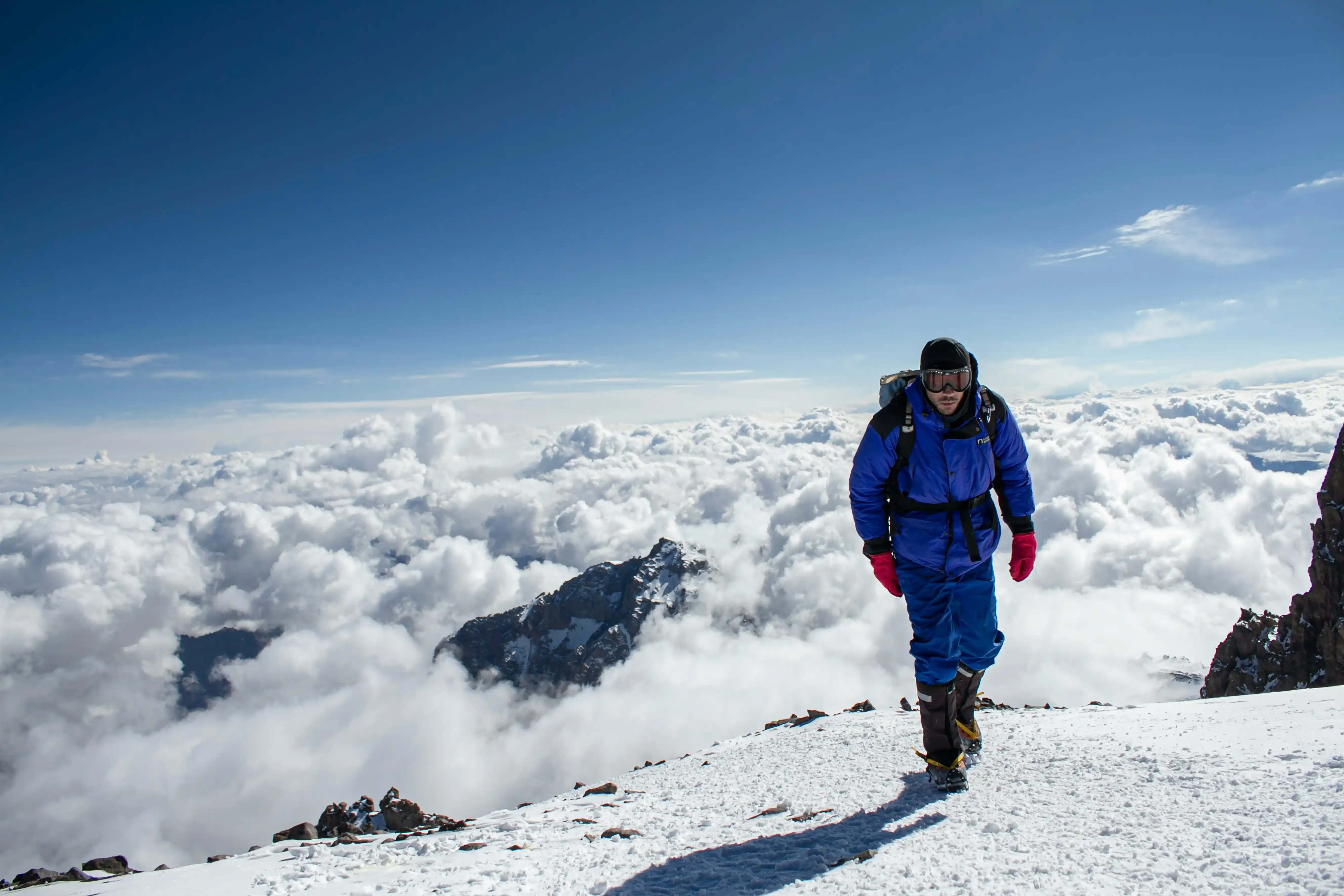
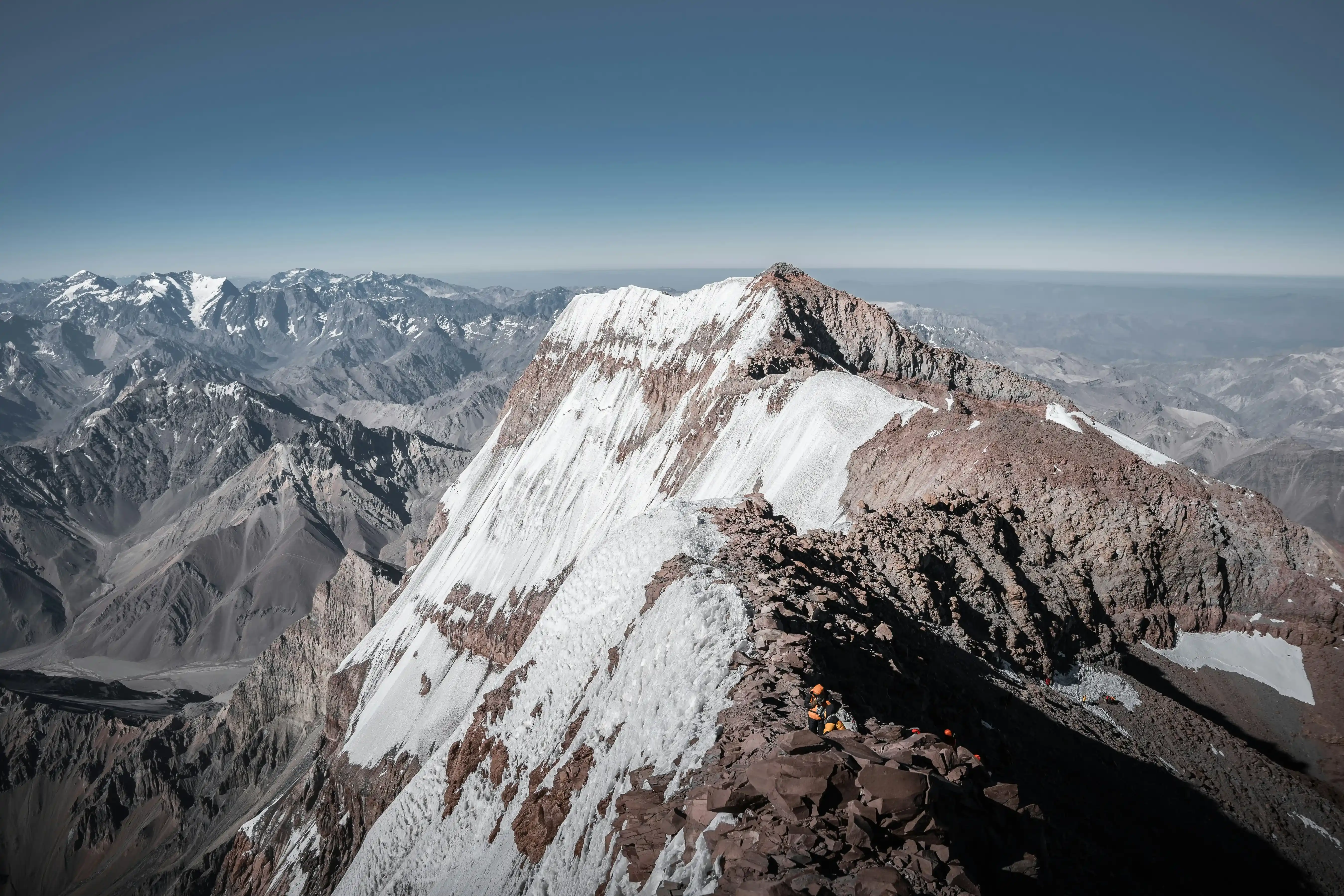
From here, climbers begin the ascent often before dawn, moving slowly up the long slopes of Piedras Blancas, past the small shelter at Independencia, through the exposed Portezuelo del Viento, and across the traverse leading to the famous Canaleta, the loose and steep final gully before the summit ridge. The last meters to the top often feel endless, but the reward is extraordinary: a 360-degree panorama of the Andes that stretches into infinity.
Upper sections and infinite views
Weather on Aconcagua: Extreme Conditions at the Edge of 7,000 Meters
Aconcagua’s weather is one of the biggest challenges of the climb. Although the mountain is technically straightforward, the environment is harsh. Winds regularly exceed 60 km/h even on calm days, and summit temperatures can reach –25°C to –30°C, with wind chill pushing it far lower. The upper part of the mountain is frequently battered by storms arriving from the Pacific, a phenomenon that can create swirling clouds, blizzards, and complete whiteouts within minutes.
December through February marks the heart of the climbing season, yet conditions remain unpredictable. Some seasons bring long periods of sunshine and stable conditions, while others deliver relentless storms that make summit attempts impossible for days. This is why every Aconcagua expedition must include flexibility in its itinerary, adding extra acclimatization and weather days to safely time the summit push.
High camp on Aconcagua
Altitude and Acclimatization: The Fundamental Challenge
Although Aconcagua is non-technical, the altitude makes it extremely demanding. At nearly 7,000 meters, oxygen levels drop dramatically, and the human body struggles to function without careful acclimatization. Headaches, nausea, fatigue, and difficulty sleeping are common reactions, and climbers must ascend progressively to give the body time to adapt.
A successful ascent of Aconcagua relies almost entirely on the quality of acclimatization. Most guided expeditions follow the principle of “climb high, sleep low,” performing carries to higher camps before moving up permanently. Many include acclimatization hikes to Plaza Francia, the lookout beneath Aconcagua’s imposing South Face, which towers nearly 3,000 meters above the valley floor.
Proper acclimatization is not only a matter of comfort but of safety. Rangers and medical staff at Confluencia and Plaza de Mulas perform mandatory health checks, monitoring climbers’ vital signs before authorizing them to continue higher. This is a crucial system that significantly improves the safety of the Normal Route.
Logistics: Permits, Mules, Base Camps and Access
Climbing Aconcagua requires organization and understanding of the logistical system managed by the Aconcagua Provincial Park. Before entering the park, every climber must obtain a climbing permit, which can only be issued in Mendoza. The price varies depending on the season, nationality, and whether you use logistics services.
Mule transport is one of the core elements of the Aconcagua approach. The trek from the trailhead to Plaza de Mulas is long, dry, and physically demanding, and carrying all expedition gear would be impractical. For this reason, nearly all climbers hire mules for the approach, allowing heavy equipment and food to be transported directly to Base Camp. This makes the ascent significantly more manageable and helps preserve energy for higher-altitude efforts.
At Plaza de Mulas, climbers benefit from a wide array of services that make the high-altitude environment more manageable: filtered drinking water, hot meals (if contracted), waste management, communication systems, and medical care. The camp also serves as a strategic point for weather updates, gear checks, rest days, and acclimatization before heading toward the high camps.
Reaching Aconcagua: Access via Mendoza and the High Andes
The gateway to Aconcagua is the city of Mendoza, a renowned wine region celebrated for its Malbec vineyards, gastronomy, and desert landscapes. Almost all climbers spend at least two days in Mendoza preparing gear, renting equipment, buying food and fuel, and completing the permit process.
From Mendoza, climbers travel three hours west along the scenic Ruta Nacional 7 toward Penitentes and Puente del Inca, small mountain settlements that serve as staging points for expeditions. From here, it is a short transfer to Horcones, the official park entrance, where the ascent begins.
The Aconcagua Experience: A Journey Through the Heart of the Andes
What makes Aconcagua so special is not only the summit but the entire journey. The long approach through the Horcones Valley introduces climbers to the vastness of the Andes, where every horizon seems endless and the scale of nature becomes immediately humbling. The nights at Base Camp, under a sky filled with brilliant stars, offer a profound sense of isolation and beauty. The ascent through the high camps becomes a meditation on endurance, patience, and personal challenge.
Standing on the summit at nearly 7,000 meters is an extraordinary achievement, but for many climbers, the true reward lies in the process: the gradual adaptation of the body to altitude, the camaraderie among climbers, the quiet mornings breaking camp, the long hours crossing wind-swept ridges, and the deep sense of respect gained for the Andes.
Aconcagua is a mountain of contrast: accessible yet formidable, non-technical yet extremely demanding, remote yet perfectly structured for international climbers. It is a peak that pushes you physically, psychologically, and emotionally, and, in doing so, offers one of the most unforgettable mountaineering experiences in the world.
Climb Aconcagua with KooKoo Climb. Check all the info and details HERE