

Climbing in Morocco: The Complete Guide to Taghia, Todra and Tafraout
One country, three destinations, twelve months of season
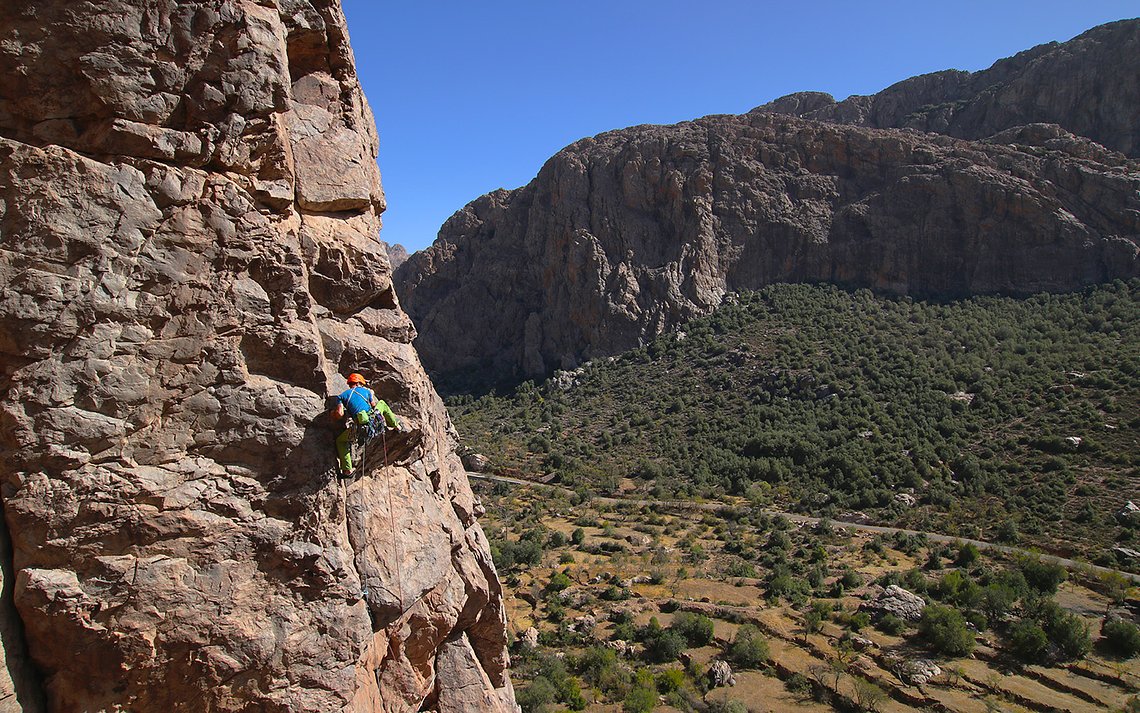
Thu 30 Jul 2026
Climbing in Morocco: The Complete Guide to Taghia, Todra and Tafraout
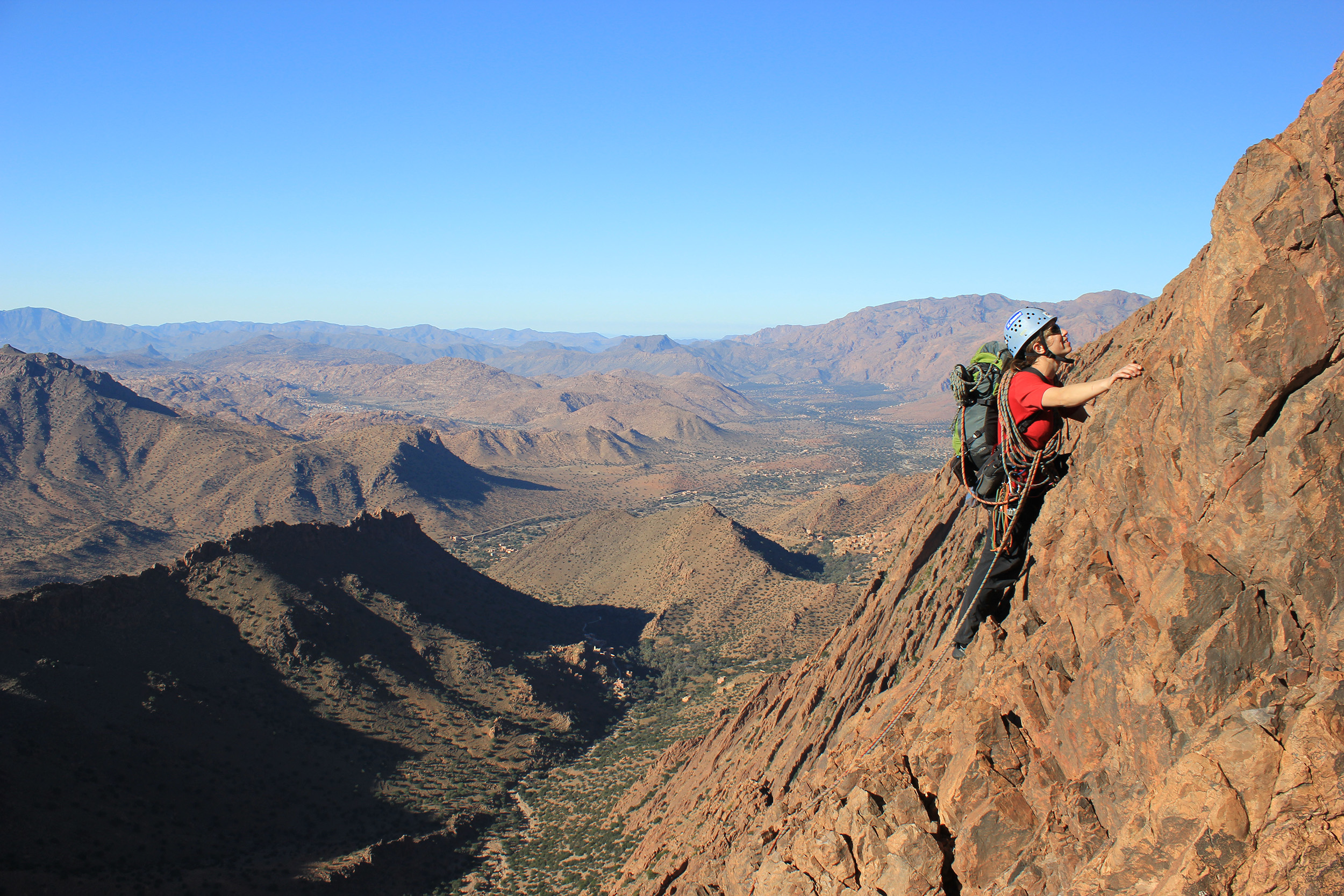
There is a moment, usually mid-afternoon, when the limestone at Taghia turns a shade of orange that doesn't look quite real. You're eight pitches up, you've got two mouthfuls of water left, and there are still four belays above you. Far below, someone is walking a mule along the riverbed. That contrast — enormous wall, tiny and very old way of life at the bottom — is what hooks people on climbing in Morocco, and it's why they keep going back.
Morocco isn't one climbing destination. It's three or four completely different ones that happen to share a passport, and that's where most trips go wrong: people arrive expecting one thing and land in another. If you want bolts every two metres and a café at the base, don't start with Jebel el Kest. If you want proper adventure — vague route-finding, ancient pegs, a long walk out — you'll be bored senseless at Plage Mansour.
This guide comes out of a good few seasons working across all three areas. It isn't a route list copied off a topo. It's what we actually tell people when they email us asking where to go, when to go, and what to pack.
Contents
- The three areas at a glance
- Why Morocco works so well for climbers
- Taghia: the limestone amphitheatre of the High Atlas
- Todra Gorge: the easiest way in
- Tafraout and the Anti-Atlas: granite, quartzite and winter sun
- Combining all three in one trip
- Logistics: flights, cars, money, signal and insurance
- Gear: what to pack for each area
- Morocco climbing guidebooks and topos
- Ethics, local respect and low-impact climbing
- Frequently asked questions
- Where to download free, properly licensed photos
- The three areas at a glance
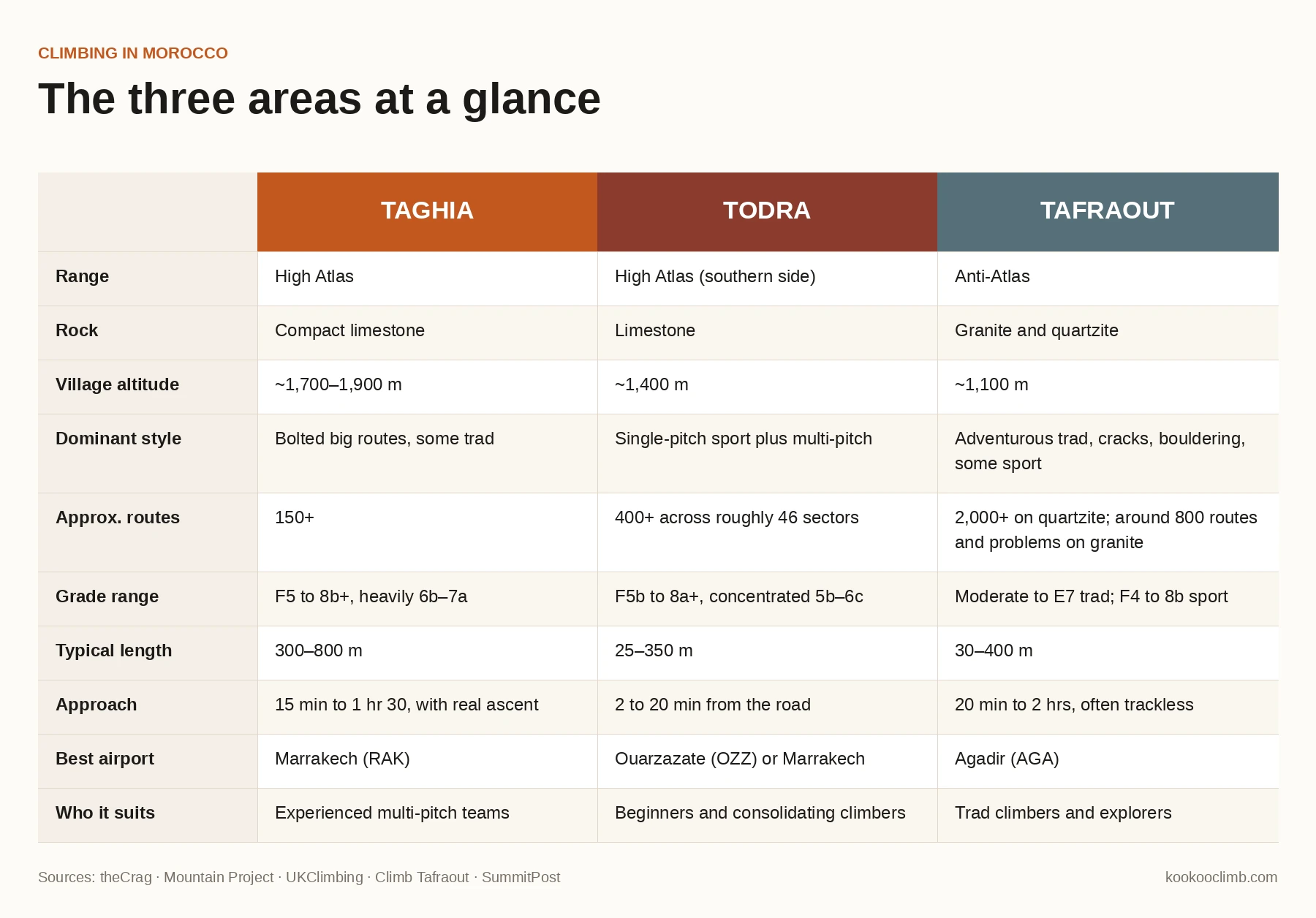
If you only read one row, make it the last one.
Why Morocco works so well for climbers
Three reasons, and one warning.
Climate. While Europe freezes, the Anti-Atlas delivers reliable sun from November through March. And by the time the south is unbearable, the High Atlas is coming into its best form. Between Tafraout and Taghia you can cover almost the entire calendar without leaving the country.
Cost. A cheap flight, a hire car split four ways, and half-board accommodation for roughly the price of a set lunch in Chamonix. A full week in Todra comes in under what a lot of people spend on a long weekend in the Alps. check our program to find out about prices.
Scale. And this is the one that matters most to us. It isn't just that the walls are big. It's that they're big and empty. You can be on Taghia's most famous route on a Tuesday in May and not see another team all day.
The warning: mountain rescue does not work the way it does in Europe. There is no helicopter half an hour from a phone call. That single fact shapes everything else — which routes you choose, how much margin you leave, what insurance you buy — and it'll come up again.
Taghia: the limestone amphitheatre of the High Atlas
What Taghia actually is
Taghia n'Aït Hakim is a Berber village of a few dozen houses, wedged into the floor of a limestone amphitheatre in the Azilal province of the central High Atlas. The village sits at roughly 1,700–1,900 m, and above it rise walls of 300 to 800 metres that shift from orange to deep brown as the light goes.
There is no road. There are no cars. There are mules, a river, a handful of family-run gîtes, and more than 150 bolted routes spread across walls with names that stick with you: Oujdad, Tagoujimt n'Tsouiant, Timghazine, Paroi des Sources, Aksoual.
People always compare it to the Verdon, or to Riglos. Neither comparison quite lands. Taghia has Verdon steepness but with alpine approaches, and the atmosphere of a high mountain valley without actually being high mountains. The limestone is compact, often crimpy and pocketed, and on the popular lines it's polished smooth by traffic.
The rock and the style
The dominant format is the bolted big route — and it's worth being precise about what "bolted" means here. It means bolts at the belays and protection through the hard moves. It also means twenty-metre run-outs on 6a terrain, because whoever put the route up decided, entirely reasonably, that ground that easy didn't need protecting. On plenty of routes, a set of nuts and a few mid-range cams isn't optional.
Taghia has a reputation for stiff grading. That's not really it. It's that the pitches are long, the rock demands good reading, and most routes go down in a big day in the heat. A fifteen-pitch 6b on Oujdad will hurt you far more than a four-pitch 7a at your local crag.
Sectors and classic Taghia routes
Oujdad is the flagship — an imposing pillar flanked by two deep gorges. It holds most of the well-travelled lines, and its 400–600 m routes are the best introduction to the valley.
Three routes appear on every list:
- - Les Rivières Pourpres — around 550 m and fifteen pitches, ED+, up to 7b+ free, or 6c/A0 if you're pulling on the odd bolt. Put up by Michel Piola, Arnaud Petit and Benoît Robert. It's the modern Taghia route and probably the most photographed. Worth saying plainly: fifteen pitches at that grade is not a morning's work.
- - La Baraka — 685 m, ED−, with a 7b crux but roughly 6b+ obligatory. It was the first fully bolted route in the area. It's the great accessible classic: long, huge atmosphere, reasonable difficulty.
- - Babel, on Tagoujimt n'Tsouiant — the biggest wall in the valley, eighteen pitches to 7c+. Different league entirely. Fast teams who are comfortable with the possibility of a bivi.
Beyond the headline three, the real charm of Taghia is the secondary walls. Paroi des Sources has shorter outings, ideal for the arrival day or for getting your fingers switched on. Timghazine holds long routes with a fraction of the traffic.
Guide's tip: don't go for the route of your life on day one. Do something four or five pitches long around 6a and calibrate how the grades feel here. Half the retreats we see would never happen if everyone did this.
How to get to Taghia from Marrakech
This is where most trips come unstuck, so let's take it slowly.
- Marrakech → Azilal. About 3 hours on tarmac, by bus or grand taxi. Azilal is the last town with a decent supermarket, a reliable cash machine and a pharmacy.
- Azilal → Zaouiat Ahansal. Another 3 to 4 hours on a twisting mountain road. Total from Marrakech is a long five hours if everything goes smoothly — and "if everything goes smoothly" is doing a lot of work in that sentence. Snow or heavy rain can close the section outright.
- Zaouiat Ahansal → Taghia. Engine off. It's an hour and a half to two hours on foot following the river, with bags carried by mule. The mule isn't folklore: with ropes, bivi kit and a week's food, you'll want it.
From Casablanca, add roughly two hours. And if you land at Marrakech in the afternoon, assume you're sleeping in Azilal or Zaouiat Ahansal before you get into the valley.
Where to stay in Taghia
The village has several family-run gîtes — Taoujdate, Aziz, Said's place, among others — that have been putting up climbers for decades. Expect simple private or shared rooms, half or full board, unreliable hot water, and tagine dinners that taste extraordinary after twelve hours on a wall. Some sit at around 1,900 m with terraces looking straight at the walls, so you eat dinner staring at tomorrow's route.
Several families in the valley now have climbers of their own. Mohamed Rezki, for instance, is actively involved in bolting and maintaining routes around Taghia. Book directly with them where you can: the money stays in the valley, and the conditions information you get over breakfast beats anything on a forum.
Season
April to October, with two sweet spots: late April to mid-June, and September to mid-October. July and August are climbable if you chase shade and start genuinely early. In winter, road access gets awkward and it's properly cold.
Common mistakes at Taghia
- - Underestimating the approach. Some walls need ninety minutes uphill before you touch rock.
- - Bringing only quickdraws. A rack of nuts and three or four mid-size cams solves a lot of problems.
- - No head torch. Obvious, and yet every season teams descend in the dark for the first time in their lives. Bear in mind that most routes range from 300m to 500m long.
- - Assuming there's phone signal. There isn't, across most of the valley.
Todra Gorge: the easiest way in
What you'll find
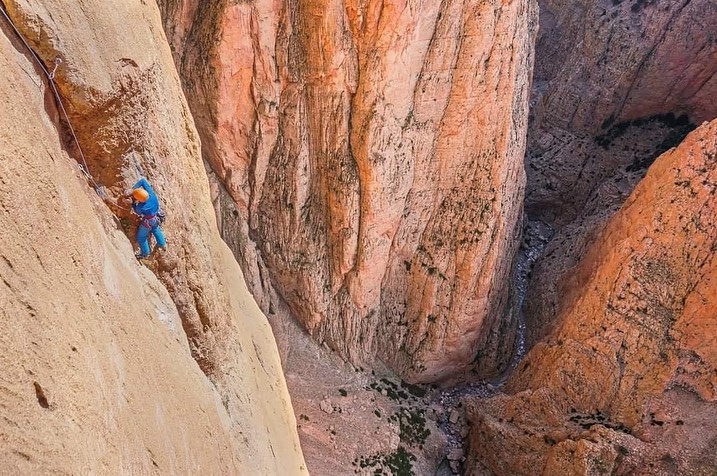
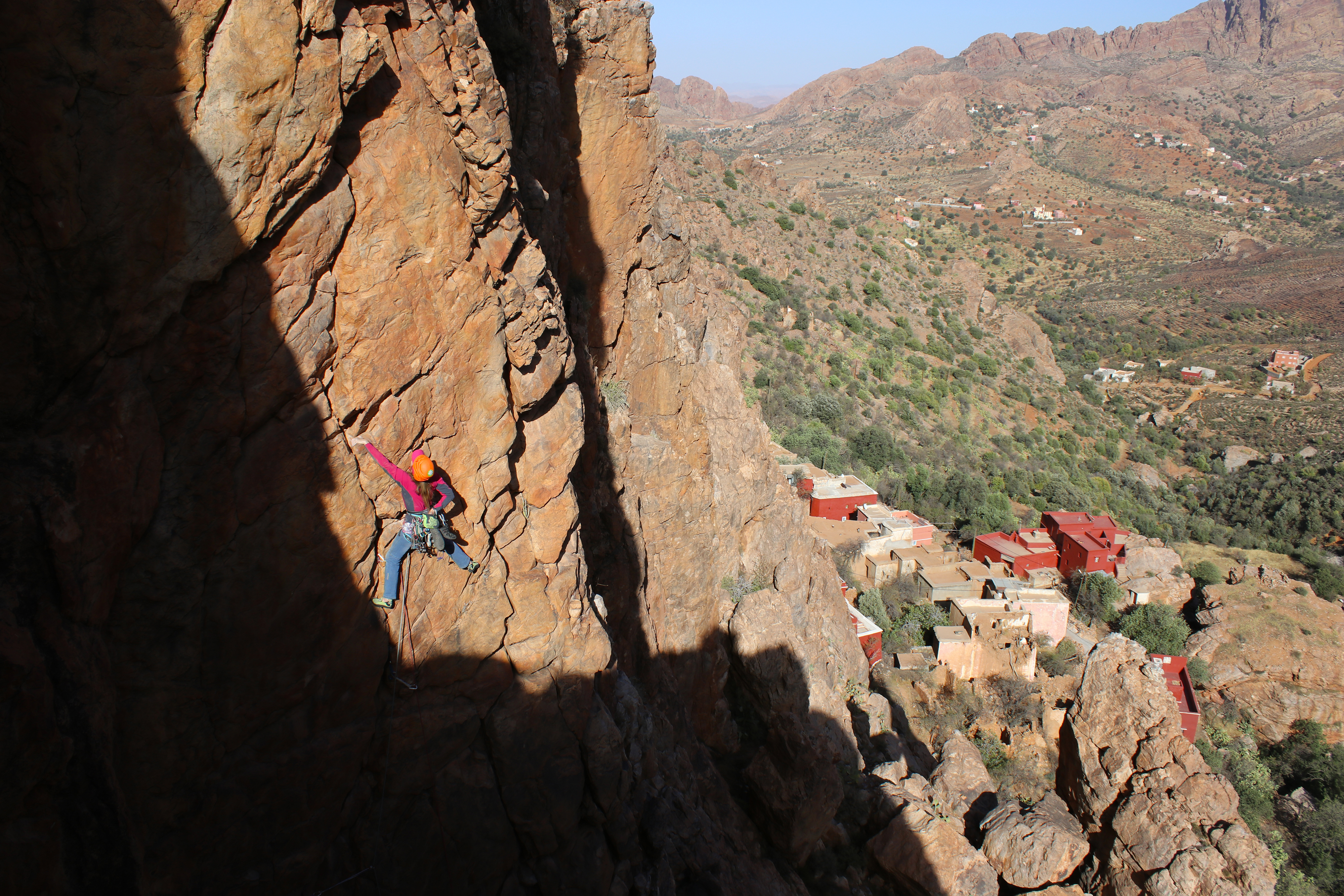
The Todra Gorge (Todgha, in the more accurate transcription) is a cleft of vertical walls up to 300 m high, cut by the river at around 1,400 m, some fourteen or fifteen kilometres from Tinghir. The road runs along the bottom. You literally park, cross the tarmac, and you're under the route.
That convenience is both its great strength and its great weakness. It's the easiest place to climb in Morocco and also the most touristed: coaches, carpet sellers and kids asking for pens are all part of the soundtrack at Plage Mansour on a Saturday morning. Five hundred metres further in, though, you can have the day to yourself.
Locals put the gorge at more than 400 routes across roughly 46 sectors. Most are single-pitch sport, but there's a very respectable stock of multi-pitch routes up to thirteen pitches and over 300 metres, plus a handful of semi-bolted and genuinely adventurous lines.
Todra Gorge climbing sectors you shouldn't miss
Plage Mansour. Right at the mouth of the gorge. Close to thirty routes, almost all between 5a and 6b, with pitches over 30 m and a few in the 48–50 m range. Vertical and slabby, well bolted. It's where anyone arriving in Morocco for the first time should start. Watch your rope: with 50 m pitches, a 60 is marginal. Bring a 70 and knot the ends.
Petite Gorge. About five kilometres in, reachable by car or on foot. Grades run from around 4+ to a stiff 8a, the rock is generally cleaner than at the entrance, and it's much quieter.
Pilier du Couchant. For a lot of people, the most compelling feature in the gorge. It holds the long classic multi-pitch routes and is firmly experienced-climber territory. Two lines get recommended over and over: the Voie Classique and Chibania.
The rest — and there are dozens of sectors — are best discovered with a topo in hand and by asking at the gorge-bottom guesthouses, which usually keep updated sketches at reception.
Grades, and who Todra suits
The bulk of the climbing sits between 5b and 6c. That makes Todra the best place in the country to:
- Get started on long single-pitch sport routes.
- Do your first multi-pitch without the approach flattening you.
- Rack up serious mileage in a few days.
- Travel with a group of mixed abilities without anyone being left out. Our groups are formed by climbers of all levels, so you'll enjoy grades an climbing style with people who climb like you.
It's where we run our multi-pitch courses, for exactly that reason: the logistics are so simple that all the energy goes into technique and belay transitions.
Season and temperatures
Spring (March–May) and autumn (September–November) are the prime seasons, with daytime highs of 20–25°C.
Winter works fine if you're selective: 10–15°C in the day, direct sun on the south-facing walls, and January nights that drop close to freezing. Bring a belay jacket for the afternoon.
Summer is brutal. Highs touch 40°C and only the shaded sectors at first light are worth anything.
Getting there
Tinghir is the base. It's about fourteen kilometres from the gorge and has everything — hotels, guesthouses, cash machines, mechanics. A shared taxi from Tinghir to the mouth of the gorge costs the equivalent of about £5–£9.
By road, Tinghir is roughly four hours from Ouarzazate and seven or eight from Marrakech on the N10. Ouarzazate (OZZ) is the most practical airport, though most European climbers end up flying into Marrakech on price and frequency.
There's also accommodation inside the gorge itself, some of it effectively at the base of the routes. Staying there has real appeal: get up, eat breakfast, and be tied in within ten minutes.
Tafraout and the Anti-Atlas: granite, quartzite and winter sun
Two climbing areas in one valley
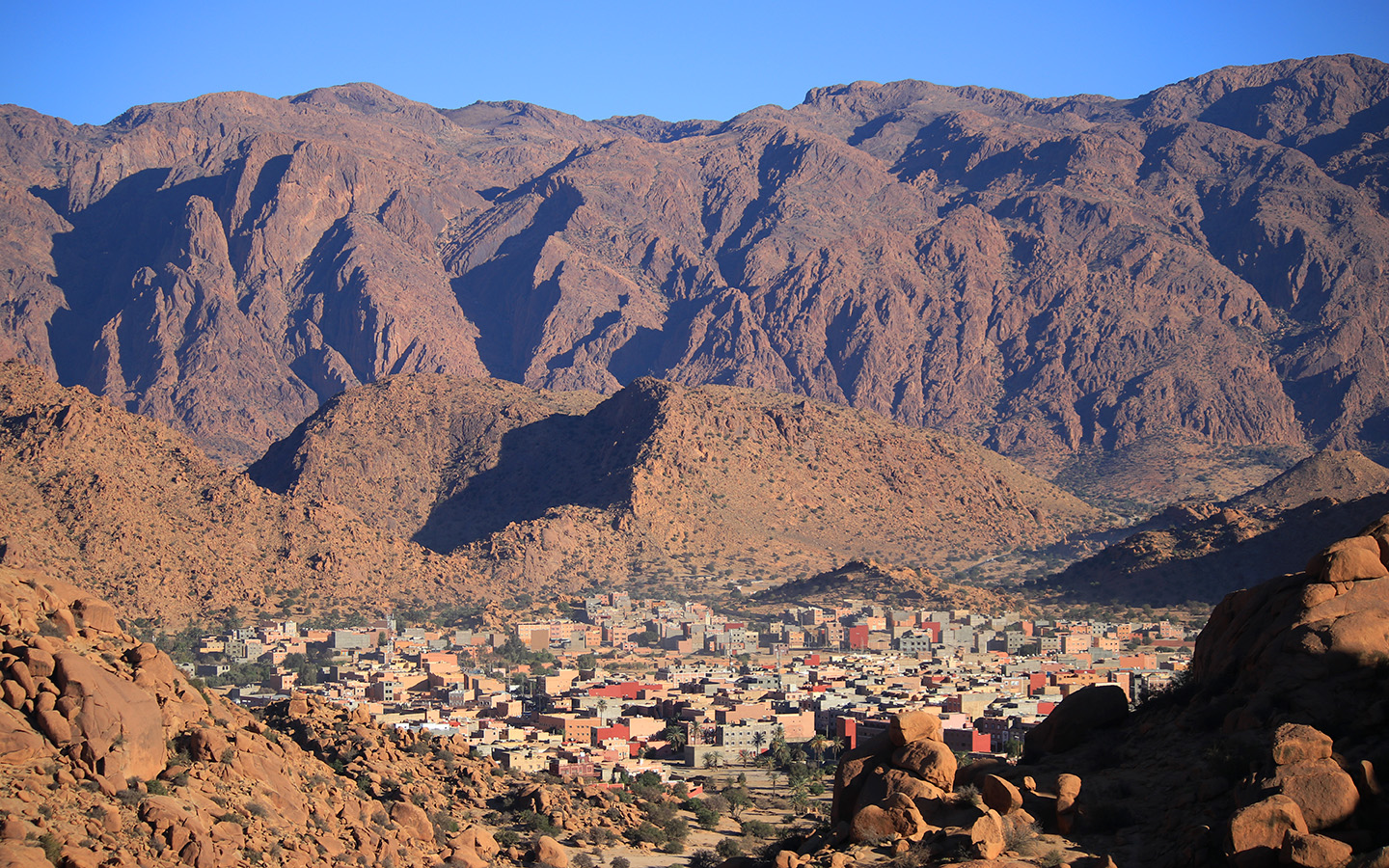
Tafraout is the place that most surprises people expecting "more of the same". It isn't. There are barely any bolted multi-pitch routes here. What there is, is traditional climbing — and a lot of very good traditional climbing.
The area offers two entirely different rock types.
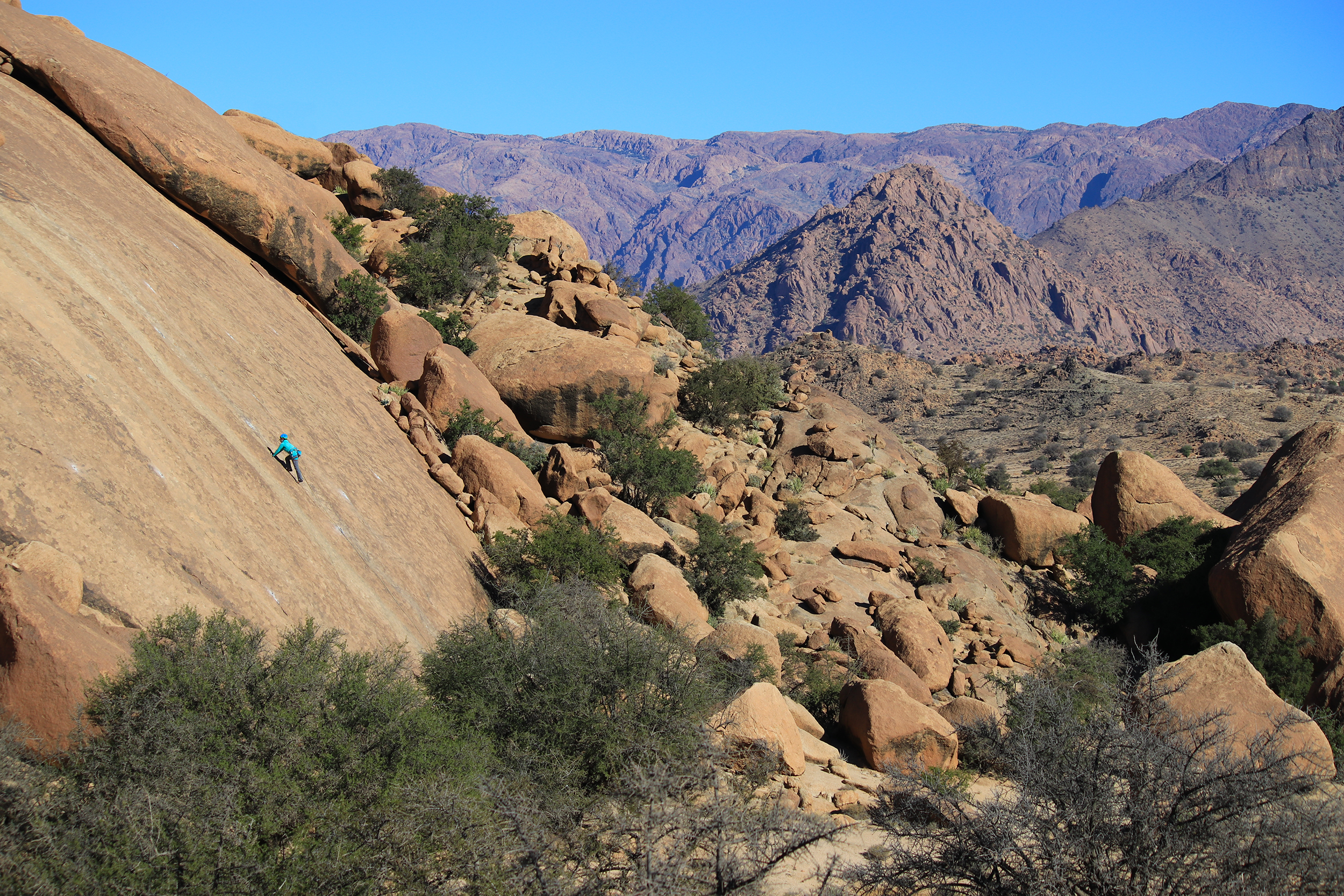
Orange quartzite on the Jebel el Kest and Jebel Taskra massifs. Remote, long, high-quality rock with generous holds and solid gear. Around 2,200 routes have been recorded on Jebel el Kest over the past two decades, the majority between Severe and E2, with the northern side far more developed — roughly a thousand routes — and much more frequented than the south. Anyone who's climbed in Snowdonia or the Lakes will feel immediately at home, except the walls are bigger and the sun is out in January.
Granite on the domes, spires and boulders ringing the town, all within about ten kilometres. Everything is here: single- and multi-pitch sport, trad, and Fontainebleau-style bouldering circuits. Recent guidebooks describe more than 800 routes and problems across some 75 crags, with grades from F4 to F8b sport, Moderate to E7 trad, and Fb4a to Fb6b bouldering.
And one figure that explains Tafraout's growing reputation: over 130 pure crack climbs, from finger locks to off-widths that leave a mark. If you want to learn to climb cracks without crossing the Atlantic, this is the place.
Crags and landmarks
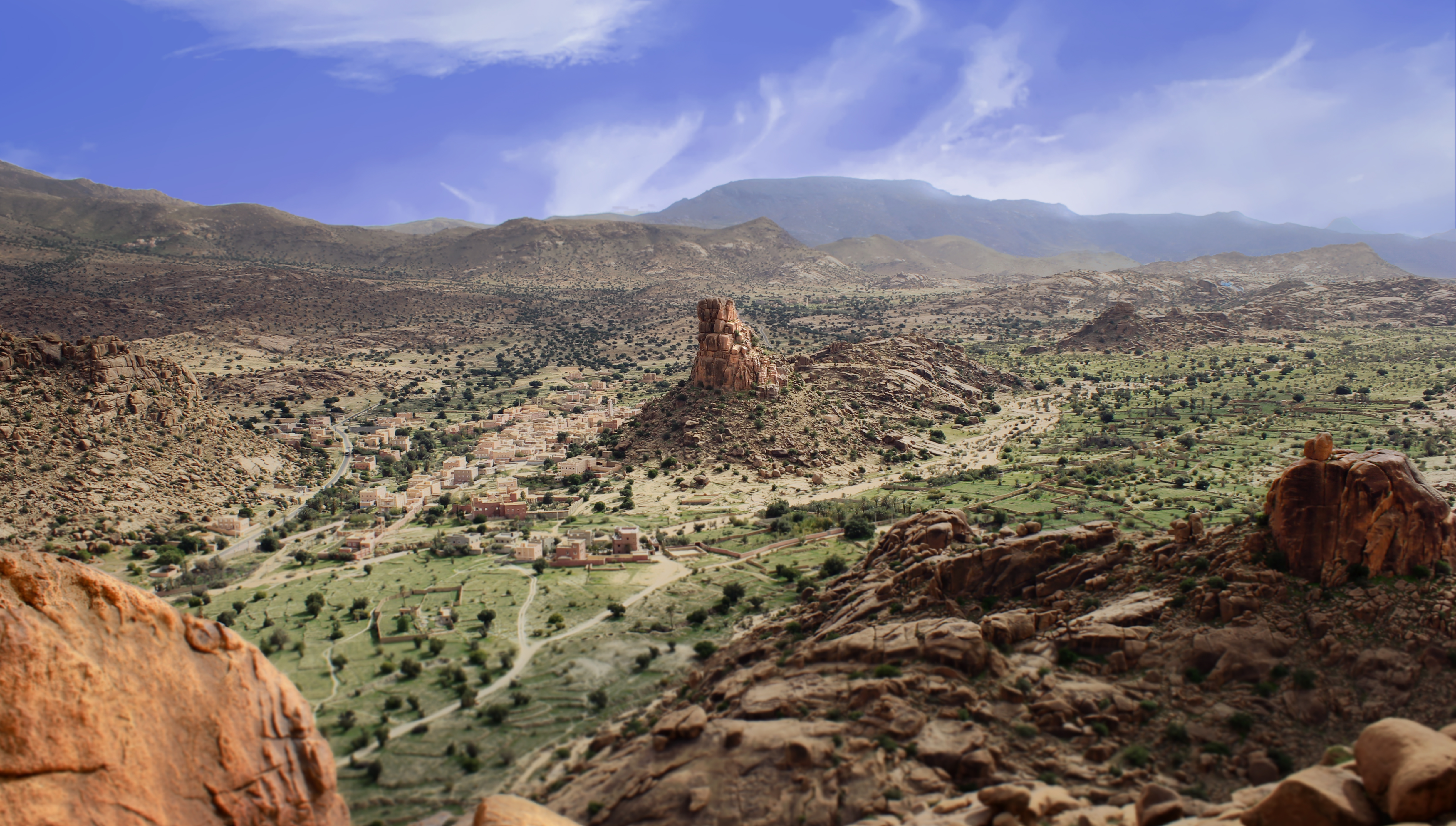
Napoleon's Hat, the granite tower above the village of Aguerd Oudad, is the visual landmark of the area. It's a walk from town on the road heading south, and it's the photograph everyone comes home with.
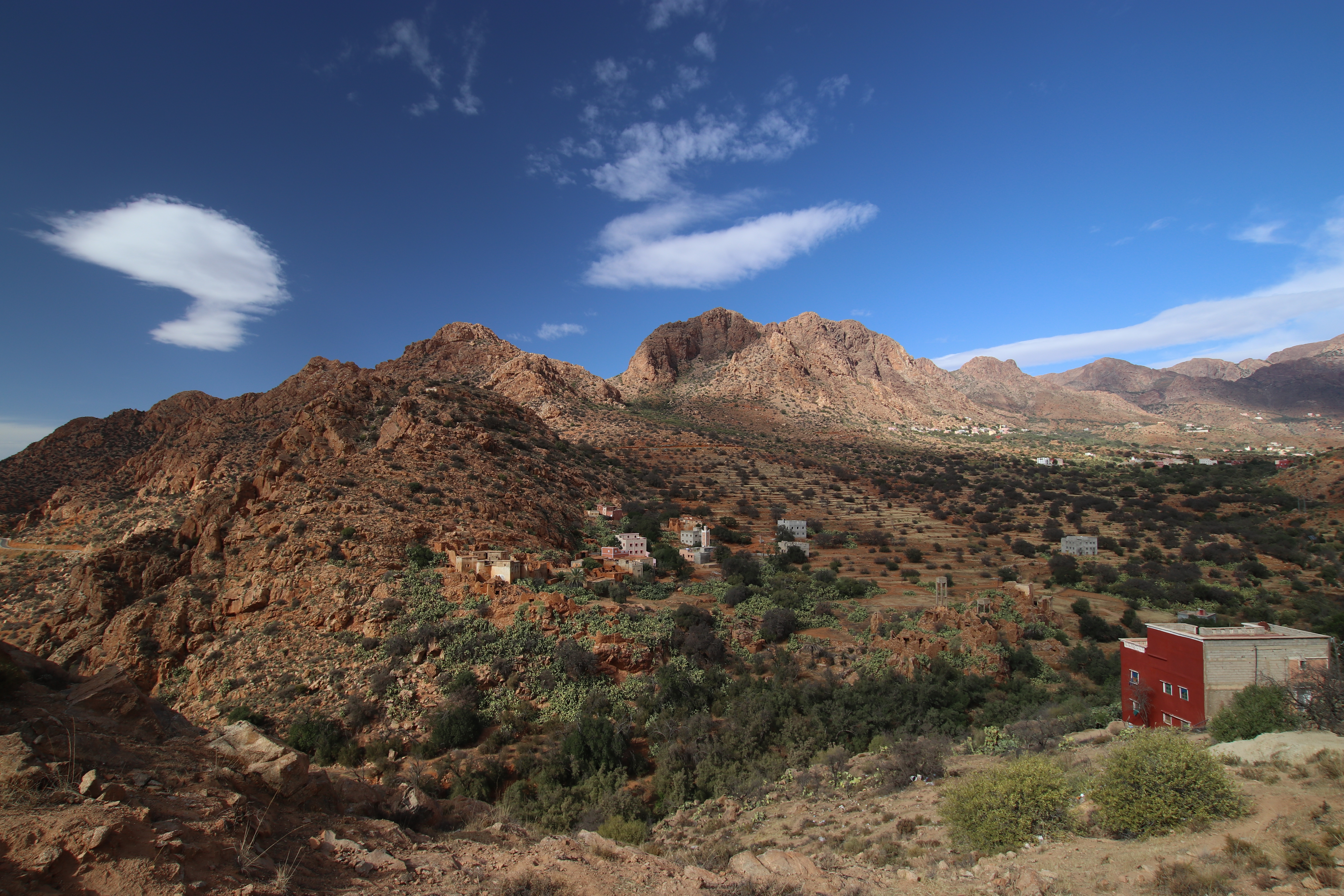
Around it are dozens of granite crags, many with fifteen- to thirty-minute approaches, and whole valleys of quartzite — the Ameln valley and its string of hillside villages among them — where days are measured in walking hours as well as pitches.
The famous painted blue rocks, daubed by Belgian artist Jean Vérame in the 1980s, are nearby and make the standard rest-day outing.
Season
The calendar inverts here. Tafraout is a winter venue: October to April, with the heart of the season between November and March. In summer the Anti-Atlas is an oven and there's no reason to go.
Which makes it the perfect counterweight to Taghia. A club that plans its year properly can have Morocco on the calendar for eight months straight, just alternating north and south.
Getting there
Agadir (AGA) is the natural airport: about two and a half to three hours by car to Tafraout on a beautiful and very twisty mountain road. From Marrakech it's six or seven hours.
You need a car here, no way around it. Unlike Todra, the crags are scattered and public transport doesn't reach them. A small hire car covers the granite fine; for some Jebel el Kest approaches, a bit of ground clearance helps.
The town has hotels, guesthouses and several climber-focused places, many with topos in the common room and hosts who know the approaches better than any book does.
Rack
Not negotiable: in Tafraout you climb on your own gear.
- Double set of cams, 0.3 to 3, plus something bigger if off-widths are on the menu.
- Full set of nuts. They work beautifully in quartzite.
- Hexes. They look like museum pieces right up until they save a pitch.
- Long slings and cord for building belays and for abseil retreats.
- Helmet. Non-negotiable, especially on the less-travelled quartzite.
Combining all three in one trip
The question we get most. Short answer: don't try to cram all three into ten days.
Morocco is big, and mountain roads flatter the map. Taghia to Todra is a full day of driving. Todra to Tafraout is another long one. Push it and you'll spend more hours in a seat than on rock.
That said, some combinations genuinely work.
Itinerary A — Ten days of sport and multi-pitch (spring or autumn)
Todra and Dades. Fixed base in Tinghir or in the gorge itself. Eight climbing days, no long drives, one rest day in the Dades Gorge or the Valley of Roses. Best climbing-per-pound of any Moroccan trip.
Itinerary B — Twelve days of big routes (May or September)
Taghia, and only Taghia. Walk in, stay, walk out. Nine or ten effective days in the valley. No scattering, no car, no phone signal. It's the trip our clients remember most, and also the one that asks the most of them.
Itinerary C — Fifteen days of contrasts (late March)
Tafraout (7 days) → transfer → Todra (6 days). Start with trad and cracks in the Anti-Atlas, cross the country with a night in Ouarzazate or Agdz, finish with sport and a multi-pitch or two in Todra. The best way to understand why climbing in Morocco can't be summed up in one sentence.
Itinerary D — Three weeks, the full tour
Tafraout → Todra → Taghia, in that order, starting late March, so that the south heats up exactly as the Atlas opens. Needs your own vehicle or a long hire, and a fair amount of flexibility.
Want us to put it together — guide, accommodation and transport sorted? Browse our Morocco climbing trips. We've worked with the same valley families for years.
Also, you can contact us at hello@kookooclimb.com if you want to find out more or need a bespoke trip for your group.
Logistics: flights, cars, money, signal and insurance
Flights
- Marrakech (RAK): best European connections, natural base for Taghia and a workable option for Todra.
- Agadir (AGA): the gateway to Tafraout.
- Ouarzazate (OZZ): most convenient for Todra, but very few flights.
Book hold luggage in advance. Ropes, hardware and sleeping bags add up fast, and desk rates are punishing. Hardware will not pass as hand luggage. All metal goes in the hold.
Cars
For Todra and Tafraout, hire one. For Taghia, think twice — you'll be leaving it parked in Zaouiat Ahansal for a week.
A standard hatchback handles 90% of the access. The other 10% — tracks towards remote Jebel el Kest bases, or the Azilal–Zaouiat Ahansal stretch in poor conditions — wants ground clearance. Check the spare wheel before you leave the airport car park, not halfway up a piste.
Driving in Morocco is easy outside the cities and chaotic inside them. Gendarmerie checkpoints are frequent, polite and quick: keep your documents to hand and stick to the limits, which are signed and enforced.
Money
Dirhams can't legally be taken out of the country and aren't easy to get hold of abroad. Withdraw cash at the airport or any city ATM. In Taghia there are no cash machines and no card terminals — everything you'll spend in the valley, from the gîte to the mules to tips, has to be in your pocket in small notes.
Signal and connectivity
Buy a local SIM on arrival. It's cheap and works surprisingly well on the road. Todra Gorge has near-total coverage. Tafraout is good in town and patchy in the hills. Taghia is effectively a dead zone — there's a known spot or two in the valley where signal creeps in if you stand on the right rock, and that's it.
If you're heading to Taghia or the remoter Anti-Atlas, a satellite communicator with an SOS function stops being a luxury.
Insurance
Here's the boring bit that can save the whole trip.
You need a policy that explicitly covers rock climbing and mountain rescue in Morocco, with repatriation. Plenty of standard travel policies exclude climbing by default, and a fair few credit cards that "include travel cover" cover none of this.
And to repeat the point from the top: organised rescue is not an Alpine service here. An accident high on Oujdad can mean hours before anyone reaches you. Pick your objectives with that in mind.
Safety
Morocco is a safe country to travel in, and the climbing areas are safer still. The genuine risks aren't crime — they're dehydration, sunstroke, rolled ankles on trackless approaches, and a rough stomach for the first two days. Bottled or filtered water, serious sun protection, and a bit of sense about food.
Gear: what to pack for each area
Common to all three
- Helmet. Always.
- Two 60 m ropes minimum; make it 70 m for Todra if you can.
- First aid kit with an elastic bandage, wide tape and oral rehydration salts.
- Head torch with spare batteries, even if you're planning to be down by five.
- A big hydration bladder, or two litres per person. Three in Todra in spring.
- Approach shoes with real soles. Running trainers don't cut it on scree.
Extra for Taghia
- A set of nuts and four to six mid-range cams.
- Long slings — the routes wander and rope drag punishes you.
- Windproof and a light insulated layer. It's breezy up there even when it's 30°C at the base.
- Spare abseil kit: cord, maillons, a backup belay device.
- Dry bags for anything going on a mule.
Extra for Todra
- 15–18 quickdraws for the longer pitches.
- A chalk brush. Some sectors are polished and the holds get greasy.
- A big haul bag — you're unloading straight from the car.
Extra for Tafraout
- Double rack of cams 0.3–3, plus a 4 and a 5 if you're after wide cracks.
- Full set of nuts and a few hexes.
- Plenty of tape. Granite cracks eat hands.
- Paper guidebook and a GPS with the approaches loaded. Cross-country access is easy to lose.
Morocco climbing guidebooks and topos
Buy the guidebook. Genuinely. The online information is fragmented, sometimes out of date, and almost never covers approaches in the detail you need at seven in the morning in a valley with no signal.
Tafraout and the Anti-Atlas. The reference is Climb Tafraout: Moroccan Anti-Atlas, whose revised third edition came out in October 2024 with over a hundred additional routes. It describes more than 2,000 routes from moderate grades to E7, plus a selection of sport crags. There's also a dedicated granite volume, Tafraout Granite, covering the shorter routes, the cracks and the bouldering circuits. And the Oxford Alpine Club's Morocco Rock – The Anti-Atlas Mountains covers the quartzite from a more mountaineering angle.
Todra. Several local topos and updated sketches circulate, sold at the guesthouses in the gorge. For planning from home, theCrag and Mountain Project hold the most complete and reasonably maintained databases.
Taghia. The French reference topo is available through specialist European retailers and, with luck, at the gîtes themselves. Consider it essential: some routes share a start and diverge halfway up a wall, and the cost of getting that wrong is high.
Ethics, local respect and low-impact climbing
Taghia, Todra and Tafraout aren't climbing parks. They're inhabited valleys where people have farmed terraces, herded animals and managed irrigation channels for generations. Our deciding to hang off their walls doesn't change that.
A few things that make a real difference:
Spend locally. Family gîtes, muleteers, village taxis, cooks. The direct economic impact of a group of eight climbers on a valley like Taghia is enormous, and it's the reason we're welcome.
Dress sensibly in the village. On the wall, wear what you like. Walking through the village, a T-shirt and something below the knee. Costs nothing, avoids awkwardness.
Ask before photographing people, especially women and children. If the answer is no, it's no.
Take absolutely everything out. Old slings, cord, loo roll, energy bar wrappers. Where there's no waste collection, whatever you leave stays forever.
Don't re-bolt on your own initiative. If you find a bolt in poor condition, report it to the local equippers. There are people in the valley actively maintaining routes who understand the original intent of each line.
Go easy on the water. In the Anti-Atlas it's a genuinely scarce resource, not a brochure line.
Frequently asked questions
When is the best time to climb in Morocco?
It depends on the area. Taghia works April to October, at its best in May–June and September. Todra is at its best in spring (March–May) and autumn (September–November), and is climbable in winter if you follow the sun. Tafraout is a winter venue: October to April. Combine north and south and you can climb in Morocco almost year-round.
Is it safe to climb in Morocco?
Broadly, yes. Morocco is a safe country for travellers and the climbing areas more so. What differs from Europe is the response to an accident: there's no fast, organised mountain rescue system. Buy insurance that explicitly covers rescue and repatriation, climb with margin, and carry a satellite communicator in remote areas.
Do I need a hire car?
In Tafraout, definitely yes. In Todra it helps a lot but you can manage with shared taxis from Tinghir. In Taghia it's no use beyond reaching Zaouiat Ahansal, because the final leg is on foot.
What grades do I need to climb to feel comfortable?
For Todra, if you're solid at 5+ or 6a you've got hundreds of routes available. For Taghia, beyond the grade — comfortable 6b is a sensible minimum — you need multi-pitch craft: belay transitions, abseils, time management and the ability to retreat. For Tafraout, it's mostly about placing your own gear; the grade matters far less.
How many routes are there in each area?
More than 150 at Taghia. More than 400 across roughly 46 sectors in the Todra Gorge. In the Anti-Atlas, around 2,200 recorded quartzite routes on Jebel el Kest plus some 800 granite routes and boulder problems around Tafraout.
Do I need a trad rack?
In Tafraout, essential. At Taghia, strongly recommended — many big routes have unprotected sections. In Todra, not needed for sport climbing, but bring it if you're heading for the Pilier du Couchant classics.
Can I drink the water?
In the villages, stick to bottled or filtered. In Taghia the river water is used daily, but if your stomach isn't used to it, filter or purify. The first two days are the ones that catch people out.
What language is spoken in the climbing areas?
Berber (Tamazight) and Moroccan Arabic day to day. Within climbing, French is the lingua franca — nearly all gîte owners and guides speak it. English is widely understood in Todra and Tafraout because of tourism, less so in Taghia.