

The Rise of Climbing Gyms: How Indoor Climbing Conquered the World (2026 Data)
Thu 9 Jul 2026
The Rise of Climbing Gyms: How Indoor Climbing Conquered the World (2026 Data)
Twenty years ago, climbing was something a handful of eccentrics in wool jumpers did on remote cliffs. Today, on any given Tuesday at 7 pm, you're more likely to queue at your local bouldering wall than at the supermarket. Indoor climbing has gone from subculture to global phenomenon: a market now worth over $3 billion a year, growing at double digits, and putting tens of millions of people on colourful plastic holds.
This article breaks down the boom with real, verifiable data: how many climbing gyms exist in the world and per continent, how many people use them, what's happening to the business model, and how many gym climbers actually want to transition outdoors.
Ready to make the move from indoor climbing to real rock?
Join our all-inclusive climbing program in Morocco, where two certified climbing guides will coach you every step of the way. Learn the skills, build your confidence, and experience the freedom of climbing outdoors in one of the world's most spectacular destinations.
What you'll find in this article
- The numbers behind the boom: a $3.4 billion market
- Why indoor climbing exploded: the 6 causes
- How many climbing gyms are there? A continent-by-continent map
- How many people climb: members and participants
- From plastic to rock: how many want to make the transition?
- 2025–2026: the end of the easy boom, the start of maturity
- Frequently asked questions
The numbers behind the boom: a $3.4 billion market
Let's start with the money — that's where you measure how serious any "trend" really is. According to Global Market Insights, the global climbing gym market was worth around $3 billion in 2024 and is set to grow at a compound annual rate of ~9.9% through 2034. Straits Research puts it at $3.4 billion in 2025, projected to reach $8.07 billion by 2034. Figures vary by research firm — treat them as orders of magnitude, not accounting — but they all agree on the essential point: sustained double-digit growth for a decade.
The geographic split of the business, according to Grand View Research:
- North America: ~39.5% of the global market (2025), the dominant region.
- Europe: ~30% of the market, led by Germany, France and the UK.
- Asia-Pacific: the fastest-growing region, with a projected CAGR of 10.4%.
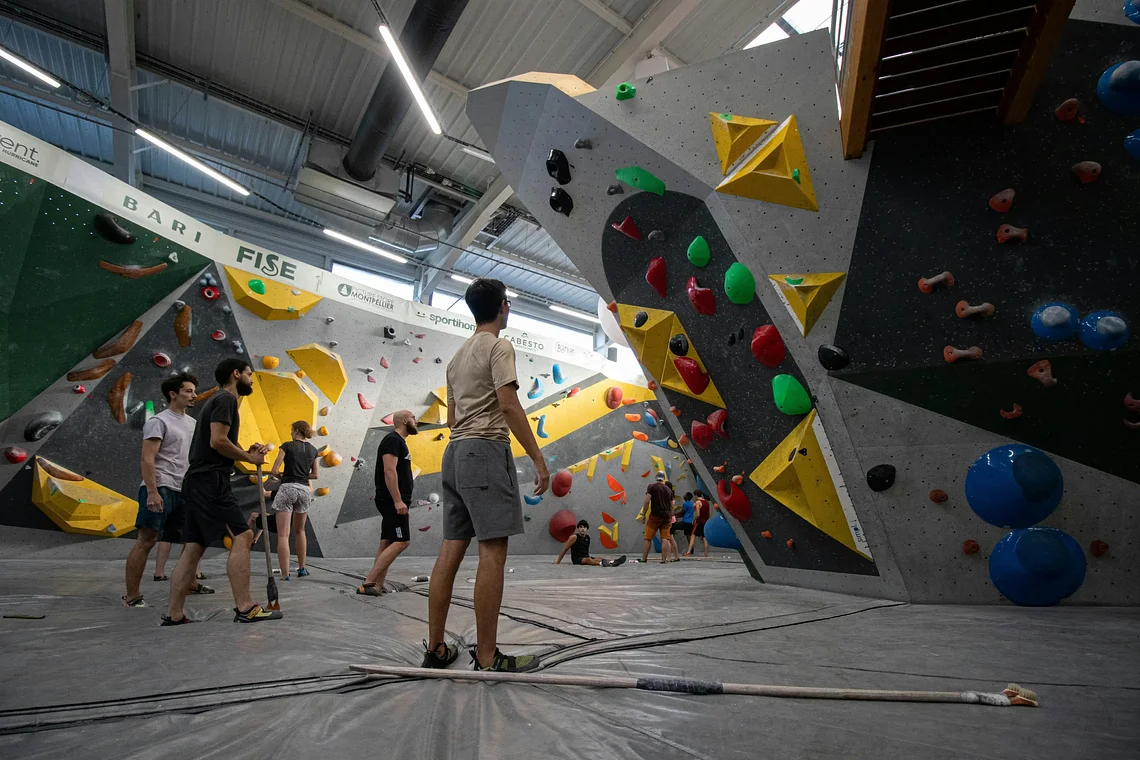
One structural stat defines the current era: bouldering-only gyms are now the majority segment, holding a 52.8% share according to global and Asia-Pacific industry reports. That's no accident — as we'll see next, bouldering is the fast food of climbing: cheaper to build, easier to consume, no ropes, no courses, no partner required.
Why indoor climbing exploded: the 6 causes
1. The Olympic effect
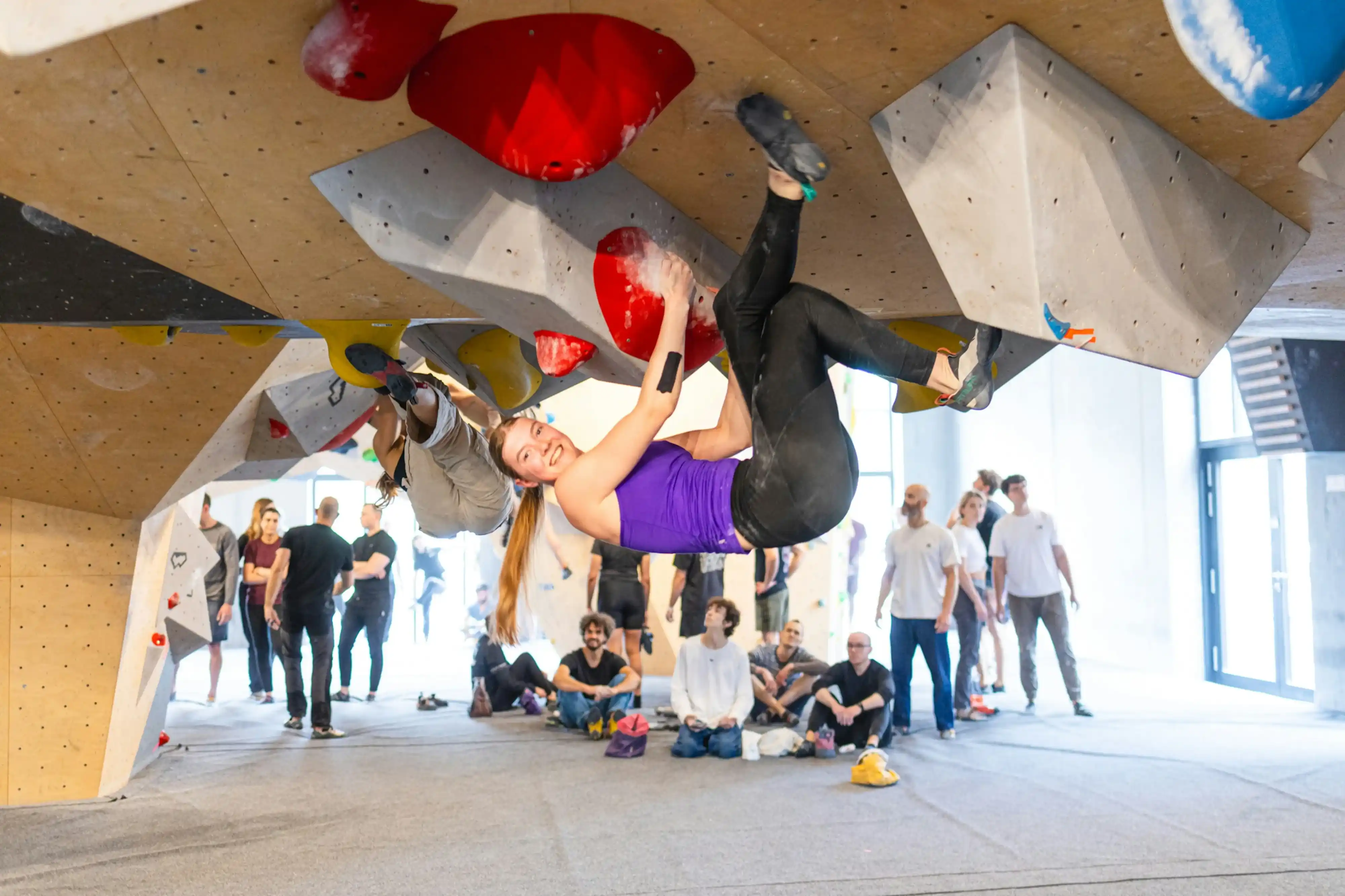
Sport climbing's inclusion at Tokyo 2020, its consolidation at Paris 2024 and its place at Los Angeles 2028 changed the public perception of the sport. Industry reports estimate the Olympic spotlight boosted climbing gym participation by around 25–30% (GM Insights, WifiTalents). Janja Garnbret and Alberto Ginés did for climbing walls what Michael Jordan did for basketball shoes.
2. Bouldering removed every barrier to entry
The genius of the bouldering model is that it reduced friction to zero: no harness, no rope, no belay certification and — crucially — no partner needed. You walk in, rent shoes, and you're climbing within five minutes. In the UK, 67% of facilities opened in the last four years are bouldering-only, according to the Association of British Climbing Walls. For operators, costs are lower too: shorter buildings, no auto-belays, no rope qualifications.
3. It's Gen Z's "third place"
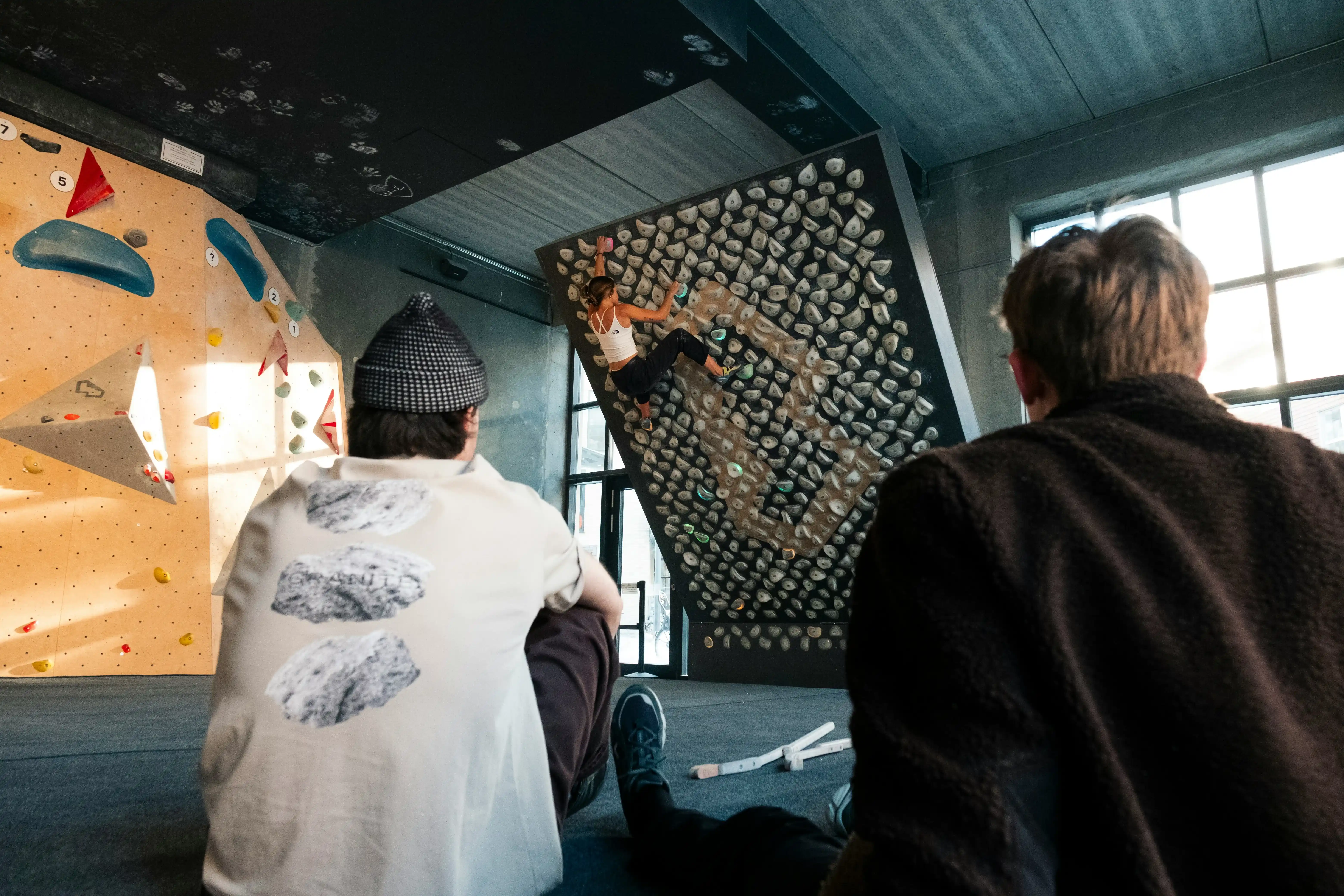
Millennials and Gen Z make up over 65% of indoor climbers, with an average age of 28 (WifiTalents). For a generation that drinks less alcohol and wants to socialise away from bars and screens, the climbing gym works the way the pub worked for their parents: you meet up, chat between attempts, fail publicly with dignity, and grab a coffee at the gym café. Operators know it — which is why new gyms increasingly look like specialty coffee shops with 4.5-metre walls attached.
4. Fitness with a purpose
Climbing solves the traditional gym's motivation problem: nobody gets bored solving a puzzle. It's strength, mobility and mental training disguised as play. In the era of functional fitness, few activities blend the physical and the cognitive better — and none generates as much involuntary conversation between strangers.
5. Urbanisation and institutional investment
The climbing gym boom is also a real-estate story: disused industrial warehouses converted into temples of plastic in dense cities far from real rock. Add public and private investment in leisure and wellness infrastructure, plus the arrival of institutional capital and chains: in the UK, 49% of facilities now belong to groups or chains (up from 37% in 2021), according to ABC Walls.
6. Pop culture did the rest
From Free Solo (2019 Oscar winner) and The Dawn Wall to Magnus Midtbø and Adam Ondra on YouTube, climbing stopped being a niche subject. The algorithm discovered that watching someone fall off a pink volume is universal content.
How many climbing gyms are there? A continent-by-continent map
A note on rigour first: there is no unified global census of climbing gyms. The figures below combine primary sources (national associations, Climbing Business Journal) with industry directories, and indicate orders of magnitude. The most cited aggregators point to between 7,000 and 10,000 commercial facilities worldwide; higher figures (20,000+) usually include school walls and non-commercial installations.
RegionFacilities (estimate)Key data and source
| North America | ~900–1,000 commercial | USA: 695+ commercial gyms (CBJ); 574 registered businesses (IBISWorld); 53 openings in 2025 |
| Europe | ~2,500–3,000 | Germany: ~550 public facilities + 2,500 school walls (DAV); Germany+France+UK: 480+ major centres; 86 new gyms opened in Europe in 2025 (Euro Climbing News) |
| Asia | ~1,500–2,000 | Japan: 500+ gyms (JMSCA); South Korea, APAC's fastest-growing market; China expanding rapidly with urbanisation |
| Oceania | ~200–250 | Australia among APAC's growth leaders (Deep Market Insights) |
| Latin America | ~150–250 | Mexico: 2 openings in 2025 and 5% growth (CBJ); Brazil, Chile and Argentina as emerging markets |
| Africa | ~50–80 | Nascent market concentrated in South Africa, Morocco and Kenya |
Three takeaways from this table:
Europe is the quiet powerhouse. North America generates more revenue, but Europe has more facilities and higher density. Germany is the extreme case: the Deutscher Alpenverein (DAV) — an alpine club with 1.5 million members — operates more than 220 climbing gyms on its own, an associative model with no equivalent anywhere in the world.
Asia is the future. Japan is already a mature market (bouldering is practically a national sport: 500+ gyms in a country with limited accessible rock), but the growth is coming from South Korea — Seoul is in the grip of a full-blown bouldering fever — and from China, where the sector is growing with the urban middle class.
North America sets the cycle. The United States is the industry's laboratory: mega-gyms (2025's largest, High Point Orlando, has 35,000 sq ft of climbing and 52-foot walls), private-equity-backed chains — and also the first signs of saturation.
How many people climb: participants and members
The participant base is hard to census, but the most solid references paint this picture:
- The IFSC (International Federation of Sport Climbing) estimates the global climbing community at over 35 million climbers; other industry estimates reach ~44 million regular participants (WifiTalents, IFSC).
- United States: indoor climbing exceeds 6 million annual participants according to sports participation panels compiled by Statista.
- Germany: over 1 million climbers, of whom more than 500,000 are boulderers — up from 70,000 practitioners in 1990. A 14-fold increase in one generation (DAV).
- United Kingdom: ~1 million people climb indoors every year, with historical growth of 15–20% annually (ABC Walls).
- Demographics: average age of 28, 65%+ millennials and Gen Z, and female participation up 12% since 2019 — climbing has one of the best gender ratios in outdoor sport.
- On paying members specifically: an average commercial gym in the US handles between 1,000 and 3,000 active members, with typical memberships around $70–90/month in mature markets. Cross-reference that with the 695+ commercial gyms in the US and the country likely has between 1 and 2 million paying members — consistent with 6 million annual participants (most visitors are occasional day-pass climbers).
From plastic to rock: how many climbers want to go "gym to crag"?
Here lies the most fascinating paradox of the boom — and the most relevant one if your business, like ours, lives in the mountains.
Most of today's climbers were born on plastic. The gym is no longer where rock climbers train in winter: it's the primary habitat. The available studies paint this picture:
- The classic Outdoor Industries Association study found that only 39% of indoor climbers also climb outdoors, while more than half of outdoor climbers also use gyms (worldmetrics). The door mostly swings one way: from rock to plastic.
- More recent surveys covered by Climbing Magazine confirm that the share of climbers who prefer the gym over the crag keeps growing.
- At the same time, the interest is real and enormous: outdoor sport climbing ("cragging") has grown ~35% in five years, driven precisely by the mass of new indoor climbers.
The three barriers (and why they're an opportunity)
When indoor climbers are asked why they haven't made the leap to real rock, the answers repeat with striking consistency. According to industry surveys, the top three are:
- Lack of gear — the jump from "shoes and chalk" to "rope, quickdraws, helmet and anchor system" is intimidating (and expensive).
- Lack of knowledge — belaying outdoors, building anchors, reading a route without colour-coded holds: none of that is learned in the bouldering cave.
- Lack of partners — outdoor climbing demands a rope team; bouldering has spoiled you into going solo.
Only ~20% say they're simply not interested in outdoor climbing. Read that backwards: four out of five indoor climbers are open to the outdoors, but most don't know how to cross the bridge. With tens of millions of indoor climbers worldwide, even a modest conversion rate represents millions of people looking for their first experience on real rock — gym-to-crag courses, certified guides, organised climbing trips. It's no coincidence that guiding schools and climbing travel operators are riding their own mini-boom in the slipstream of the big one.
The transition isn't trivial from a safety standpoint either: real rock has no marked holds, no controlled falls, no duty manager. The industry knows it, and "gym to crag" programmes run by gyms, federations and professional guides are becoming the standard gateway — and a business line in their own right.
2025–2026: the end of the easy boom, the start of maturity
The latest Gyms & Trends report from Climbing Business Journal — the industry's statistical reference, based on a survey of 240 facilities — adds the nuance missing from the enthusiastic press releases:
- 53 new gyms opened in North America in 2025 (60 in 2024) and there were 12 closures (8 in 2024): net growth of 4.7%, down from 6.3% the previous year.
- 356,314 square feet of new climbing wall were built — 23% less than in 2024.
- 73% of operators described 2025 as an economically challenging year: rising costs and flat or declining traffic at established gyms.
- "Boom times are over," summed up one multi-location operator: profitability now requires scale, and the sector is entering an era of mergers and acquisitions.
- And yet: 61% expect revenue to improve in 2026, and youth programme sign-ups grew — the talent pipeline that guarantees the next decade.
The correct reading isn't "the bubble is bursting" but "the industry is maturing": fewer opportunistic openings, more professional chains, differentiation (cafés, coworking, hybrid fitness, yoga) and — once again — services that connect the gym to the mountains as a retention play.
Frequently asked questions about the climbing gym boom
How many climbing gyms are there in the world?
There's no official census; industry estimates point to between 7,000 and 10,000 commercial facilities, with Europe holding the most centres and North America generating the most revenue.
How many people climb worldwide?
Between 35 and 44 million people according to the IFSC and industry panels, the vast majority introduced to the sport indoors. The US alone exceeds 6 million annual indoor participants.
Why is bouldering growing faster than rope climbing?
Because it removes all three barriers to entry: no personal gear, no prior training, no partner required. Bouldering-only gyms already account for more than half of new facilities.
How many gym climbers transition to outdoor rock?
Historically around 39% of indoor climbers also climb outdoors. Nearly 80% express interest, but lack of gear, knowledge and partners holds them back — a gap filled by gym-to-crag courses, guides and organised climbing trips.
Is the industry still growing in 2026?
Yes, but more slowly and more professionally: 4.7% net gym growth in North America in 2025, consolidation into chains, and 61% of operators forecasting better revenue in 2026.
Sources
Climbing Business Journal — Gyms and Trends 2025
Climbing Business Journal — 2025 Gym List Awards
Global Market Insights — Climbing Gym Market Report 2025-2034
Straits Research — Climbing Gym Market
Grand View Research — Climbing Gym Market
IBISWorld — Climbing Gyms in the US
Deutscher Alpenverein — Zahlen und Fakten zum Klettersport
Association of British Climbing Walls — Market Research 2025
IFSC — International Federation of Sport Climbing
Statista — Indoor Climbing Participants US
Climbing Magazine — Climber Survey on Indoor Interest
WifiTalents — Indoor Climbing Industry Statistics
Grand View Research — Japan Climbing Gym Market