

Rock Climbing in Northern Catalonia: The Best-Kept Secret in European Climbing
The Pre-Pyrenean limestone belt of Lleida province offers some of the finest multi-pitch climbing on the continent — yet most European climbers have never heard of it.
 by Xavi Coll
·
Wed 17 Jun 2026
by Xavi Coll
·
Wed 17 Jun 2026
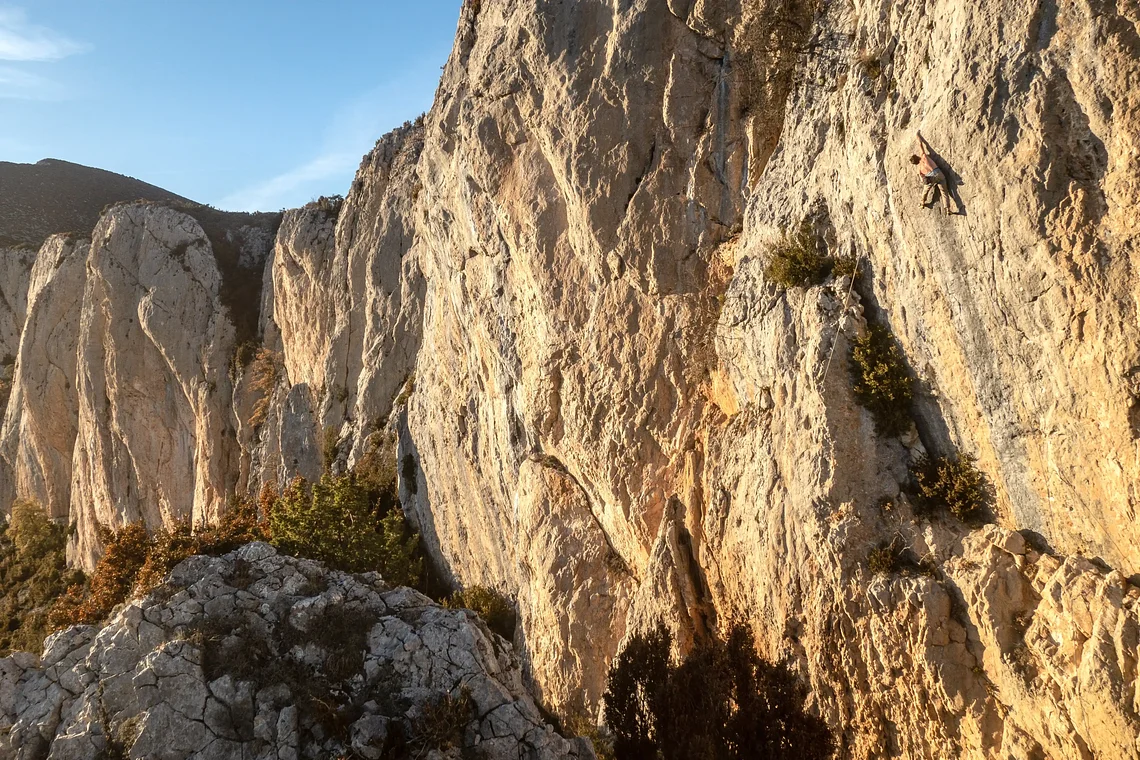
There is a moment, standing at the base of a 400-metre limestone wall in the Congost de Mont-rebei gorge, when it hits you: you are in one of the great climbing destinations of the world, and almost nobody knows it. The cliff above you is silent except for the wind threading through the gorge. A bearded vulture cuts a slow arc overhead. The Noguera Ribagorçana river, turquoise and cold, winds far below. And on the wall in front of you, the trace of a route disappears into the grey and orange stone for as far as you can see.
Northern Catalonia — specifically the Pre-Pyrenean ranges of Lleida province — sits quietly at the intersection of everything a climber could want: extraordinary rock quality, a density of areas that takes weeks to explore, a climate that makes climbing possible on almost any day of the year, and a raw, undeveloped wildness that the more famous limestone crags of southern France or the Dolomites have long since lost. This is not a polished destination. There are no crowds queuing at the base of classic routes. The villages are small, the roads are winding, and the only things in the sky, most days, are raptors.
If you have spent time in Rodellar, Siurana, or the Gorges du Verdon and you are looking for the next step — bigger walls, more adventure, fewer people — this is where you come next.
Where Is This, Exactly?
The area covered in this guide centres on the Serra del Montsec — a pre-Pyrenean limestone range running roughly east to west across the province of Lleida, northwest of Barcelona. The key climbing zones — Montrebei, Àger, Terradets, Sant Llorenç de Montgai, Camarasa, and Vilanova de Meià — are all within a two-hour drive of Barcelona, and within forty minutes of each other. The nearby town of Balaguer serves as a practical base, with Lleida capital just south for bigger amenities.
The rock throughout the region is Cretaceous limestone: compact, textured, and largely excellent. The walls are south or southwest-facing for the most part, meaning winter climbing is not just possible but genuinely good, while the higher sectors offer shade in summer. The altitude sits between 400 and 800 metres, low enough to avoid Pyrenean weather but high enough that the summer heat rarely becomes oppressive on the wall.
The Montsec Range: The Highest Walls in Catalonia
The Serra del Montsec — whose name translates roughly as "dry mountain" — is the defining feature of this climbing landscape. A continuous wall of limestone stretches for over 60 kilometres, carved by rivers into spectacular gorges. The highest walls in Catalonia are here. The most committing routes in Catalonia are here. And the most spectacular scenery in Catalonia — and that is saying something — is here.
The range is split into three main sections by the two major gorges: the Congost de Mont-rebei to the west and the Desfiladero de Terradets to the east. Between and around them, the walls rise to 500 metres in places, offering multi-pitch routes that rival anything in the Alps for position and anything in France for rock quality.
Congost de Mont-rebei: The Big Wall Capital
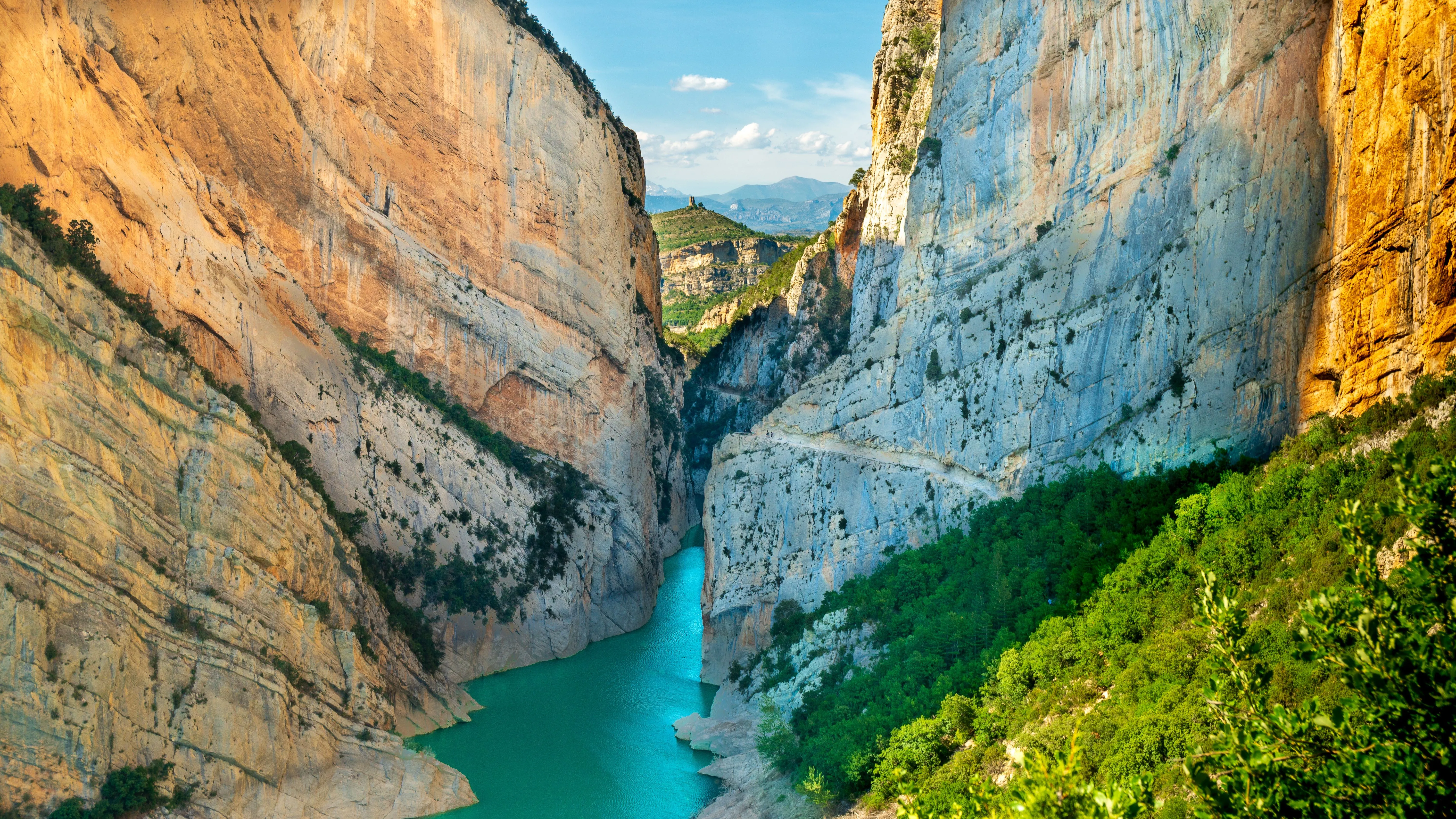
If there is a single place in this region that deserves to be on the European climbing bucket list, it is the Congost de Mont-rebei. The gorge sits on the border between Catalonia and Aragon, and the river at its floor marks the boundary between the two regions. The walls on either side — the Paret de Catalunya to the east and the Pared de Aragón to the west — rise up to 500 metres from the water, and in certain sections the gorge narrows to under 20 metres wide. It is, by any measure, one of the most dramatic landscapes in Spain.
The climbing at Montrebei is predominantly traditional or semi-traditional multi-pitch: long routes requiring trad protection alongside bolted belays, where grades run from F5 to F9a+, with a strong concentration of excellent routes in the F6a–F7b range. These are not routes to underestimate. The approaches require navigating the gorge path — itself an adventure — and the descents are committing. You need solid multi-pitch experience, a rack of cams and nuts alongside your quickdraws, and the mindset of an alpinist rather than a sport climber.
The classics on the Paret de Catalunya include Diedre Gris (400m, 6a+), one of the most celebrated limestone multi-pitch routes in Spain, and the trad adventure of Paul-Laueza (425m, V+). On the Pared de Aragón, Santiago Domingo (400m, V+) has been drawing climbers for decades. These are full-day routes, committing from the moment you leave the ground, with the kind of sustained position and exposure that most sport climbers rarely experience.
The guidebook written by Luis Alfonso (Luichi) — one of Spain's most experienced climbers and a man who used this region as a training ground — covers 269 routes on these walls alone, with difficulties running from F5 to F9a+. The fact that Luichi grew up partly on these rocks, and considers them world-class, tells you everything you need to know.
The Congost is also a protected natural space. There are no roads through it — the access path was carved into the cliff in the 1980s when the Canelles reservoir cut off the only land connection between the two sides. This inaccessibility is precisely what has preserved it. There is no infrastructure, no bar at the base of the wall, no parking lot ten metres from the first bolt. You earn these routes.
Best for: Experienced multi-pitch climbers. Adventure trad climbing. Anyone who wants to feel genuinely committed on a route.
Key routes: Diedre Gris (400m, 6a+), Paul-Laueza (425m, V+/A0), Santiago Domingo (400m, V+/A0)
Grade range: F5 to F9a+, with the sweet spot at F6a–F7b. All trad or semi-trad.
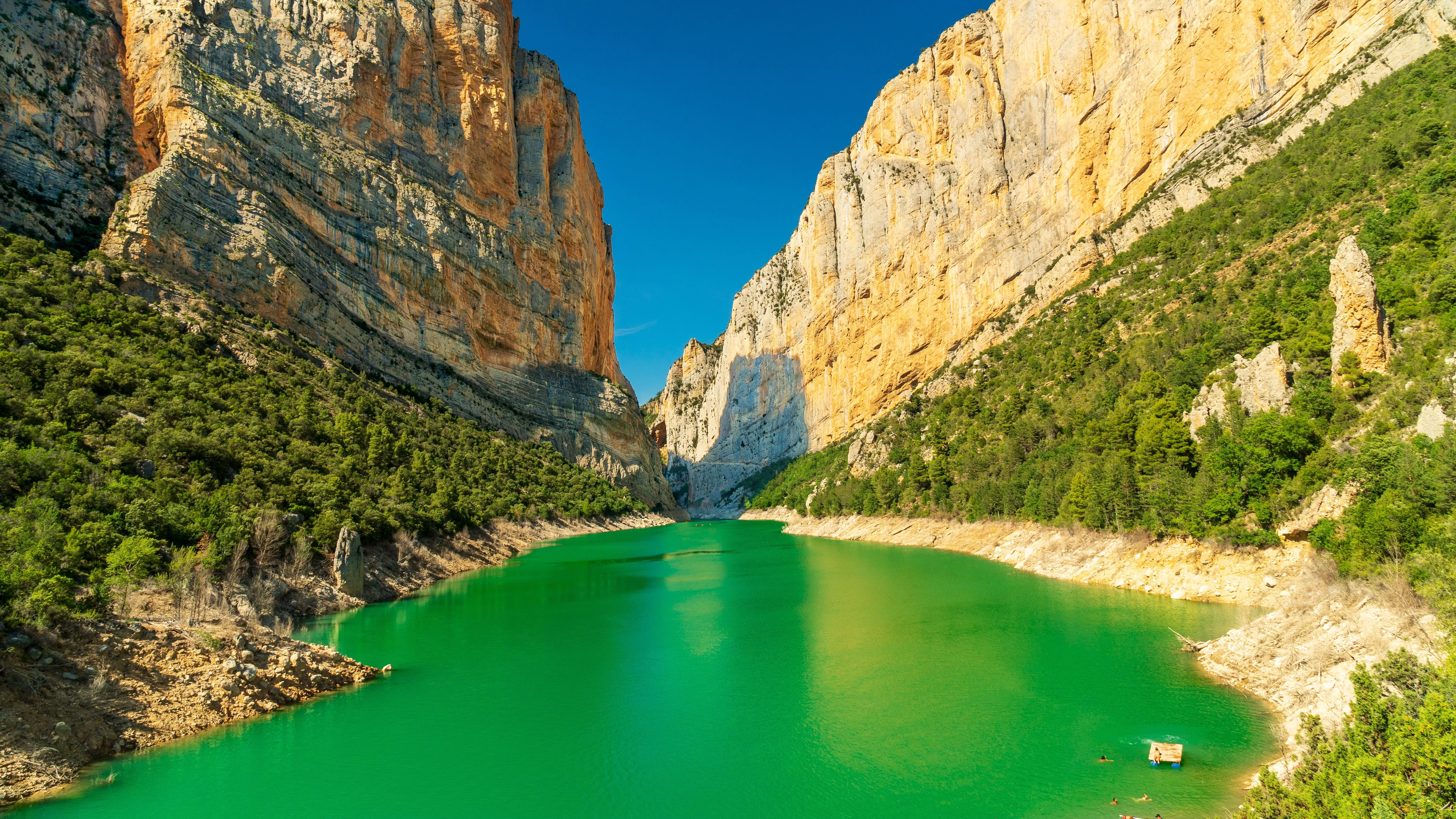
The stunning Mont-Rebei gorge and its 500-metre walls
Terradets: The Perfect Introduction to Big Limestone
Thirty kilometres east of Montrebei, the Noguera Pallaresa river cuts through the Montsec at the Desfiladero de Terradets, creating a different kind of climbing venue: still spectacular, still serious, but more accessible and with a wider range of entry points. The dominant feature is the Paret de les Bagasses — a 500-metre wall that stands above the reservoir and provides one of the most impressive backdrops for climbing anywhere in the country.
Terradets is in some ways the ideal gateway into this region's multi-pitch climbing. The bolting is more consistent than at Montrebei, the grades are relatively honest, and the routes are shorter on average, with many excellent options in the 150–300 meter range. The classics Reina Puig (500m, V+) or CADE (500m V+/Ae) on the Paret de les Bagasses are a true Catalan reference: long, varied, with superb position, and — critically — within reach for competent climbers who are still building their multi-pitch experience.
Alongside the big-wall multi-pitch, Terradets also has the Paret de les Bruixes: an overhanging bowl of limestone crammed with tufas and roof routes, almost entirely in the F7+ range, where some of the hardest sport climbing in the region is found. This is where you go on the rest day between multi-pitch objectives, to pull on something steep and athletic before returning to the wall the next morning.
The Roca Regina sector adds another 500-metre masterpiece to the tally — the Galí-Molero route (500m, V+/A0) has been a standard for generations of Catalan climbers.
The reservoir below the walls means that in good conditions, afternoon descents involve a swim. This combination of serious mountain objectives and Mediterranean ease of living is very specifically Catalan.
Best for: Climbers progressing toward committing multi-pitch. Hard sport climbers looking for a test piece sector. Groups with mixed experience.
Key routes: Reina Puig (500m, V+), Galí-Molero (500m, V+).
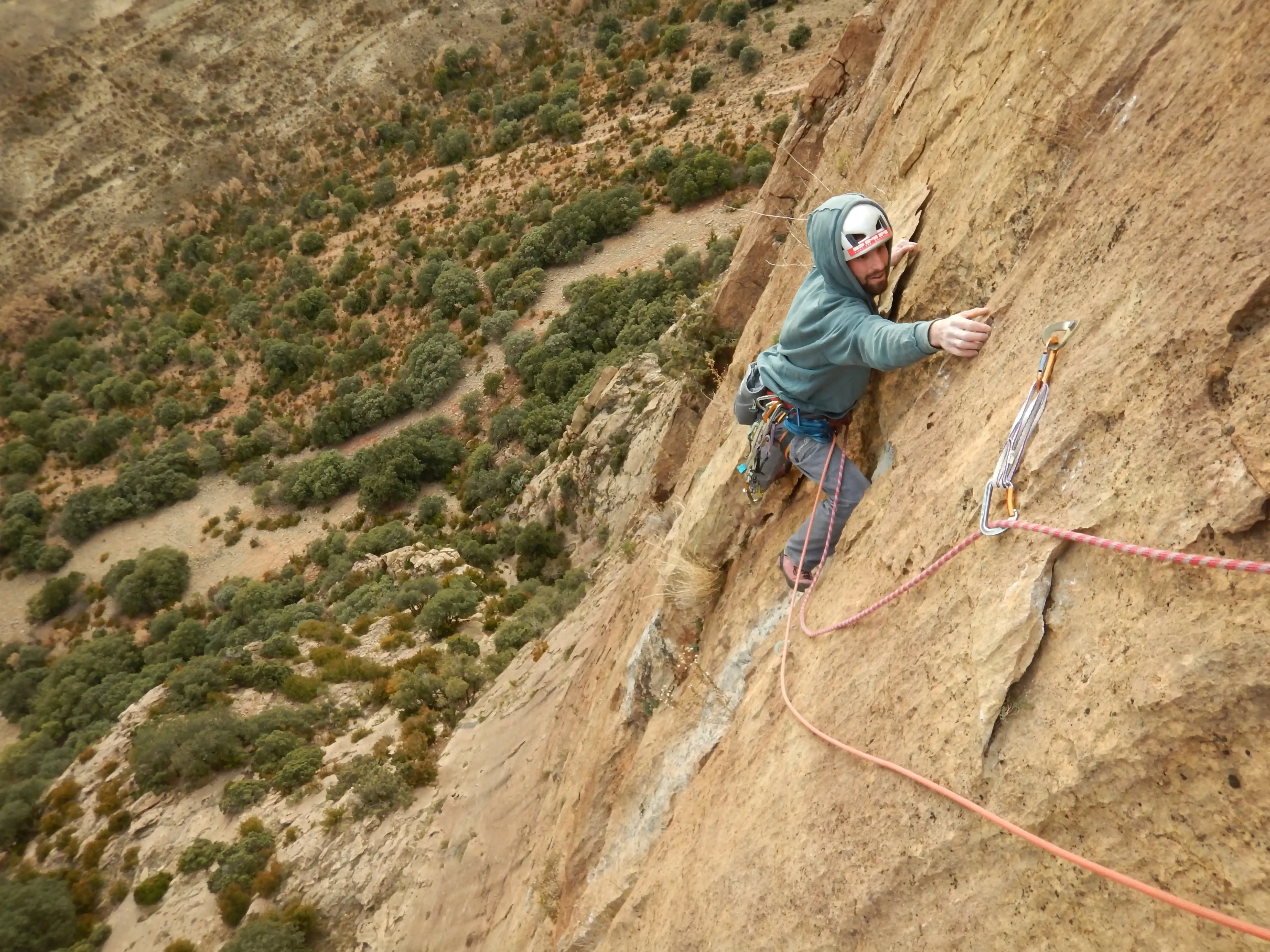
Àger: The Sun Trap That Delivers Year-Round
A few kilometres southeast of Montrebei, the small village of Àger sits above a south-facing escarpment that is one of the most reliable year-round climbing venues in northern Spain. The cliff is a sun trap — it faces almost due south and catches light from dawn to dusk — which means that on a clear January day, with the Pyrenees snowcapped in the background and not another climber in sight, you can be working an F8a in a t-shirt.
The climbing at Àger is predominantly sport, with routes running from F6b to F8b+. The rock is typical Pre-Pyrenean limestone: heavily featured, with pockets, tufas, and small edges, and in places genuinely polished on the most popular lines. The grades at Àger are known to be fairly accurate, which is appreciated in a region where some of the harder old routes carry an inflated reputation.
The sectors are spread across the escarpment above the village, with relatively short approaches and good orientation. For those who want to combine hard sport climbing with multi-pitch objectives elsewhere, Àger works brilliantly as the single-pitch complement to a Montrebei or Terradets day.
The village itself — perched on its ridge with views across the Montsec plains toward the Pyrenees — is one of the most attractive small towns in the Pre-Pyrenees. The bar in the main square serves good food. The road from Balaguer winds through olive and almond groves. It is a place that rewards staying a few days, not just passing through.
Best for: Hard sport climbers, winter climbing trips, rest days from big walls. Top quality semi-bolted multi-pitch routes.
Grade range: F6b to F8b+
Sant Llorenç de Montgai: History, Caves, and Great Multi-Pitches
Sant Llorenç de Montgai occupies a curious position in Catalan climbing history. Along with nearby Camarasa, it is one of the oldest climbing areas in Lleida province, and its hardest routes — particularly on the twin caves of the Disblia sector — were once the most difficult climbs in the region. The caves were used as a training ground by a young Dani Andrada before he went on to establish some of the hardest routes in the world. That context gives the place a certain mystique.
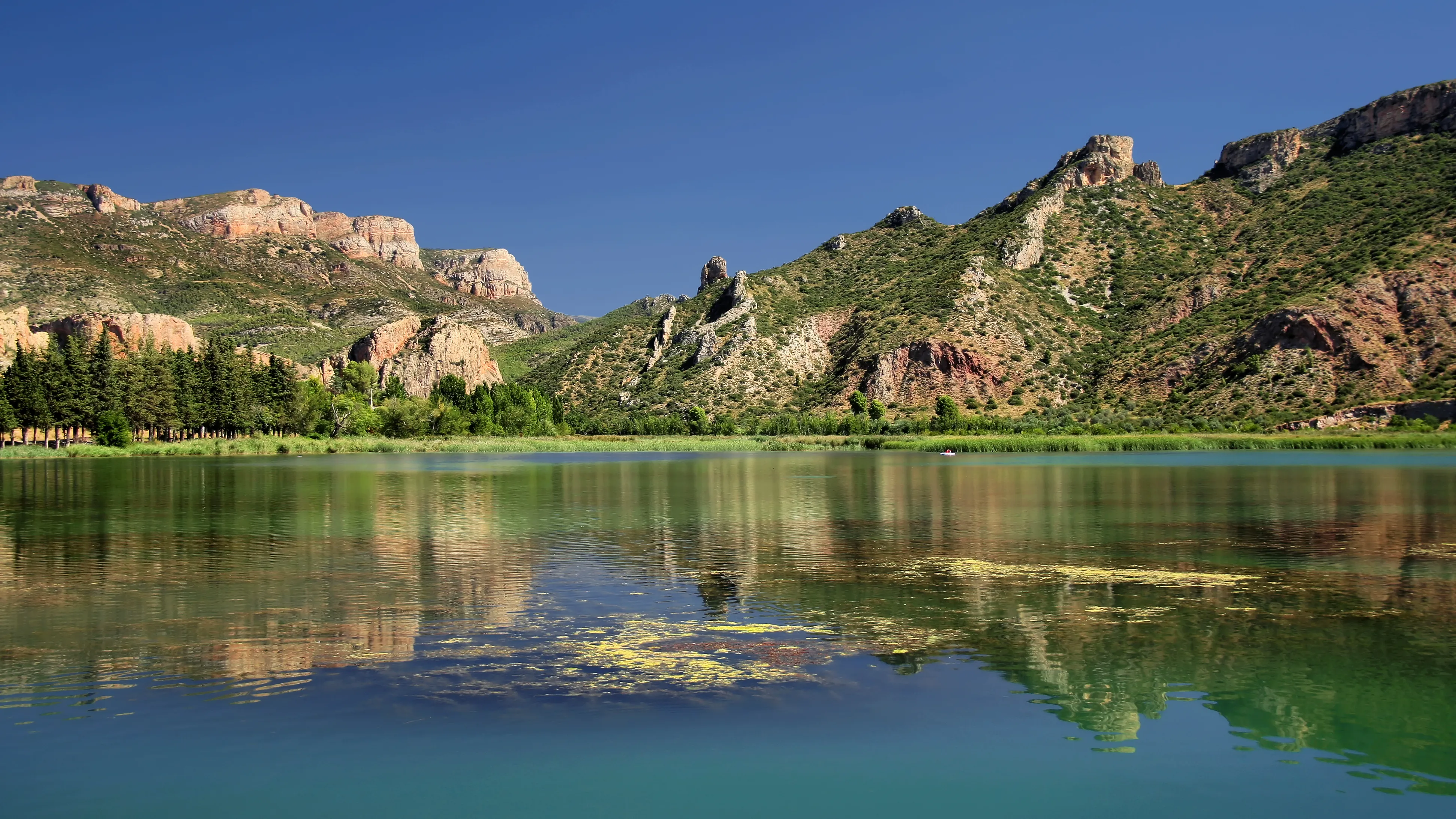
The crags sit along the shores of a long, narrow reservoir on the Segre river, about 50 minutes north of Lleida and 40 kilometres from Balaguer. The setting is beautiful in a quietly Catalan way: limestone walls reflected in still water, almond trees on the hillsides, and on a weekday morning in autumn, a stillness that is almost total.
The climbing falls into two distinct personalities. Down by the water, the steeper sectors — Disblia, Paret de l'Os, Xinxetes, and Mordor — offer single-pitch and short multi-pitch routes on overhanging conglomerate and limestone. The Disblia caves are still considered extremely hard test pieces; the routes on Xinxetes and Mordor are more modern in character, with long, sustained pitches on gently overhanging conglomerate that demand endurance over power. Grades across these sectors run from F7a to F9a, with the harder routes genuinely challenging despite their comparatively modest reputation outside Spain.
Higher up the cliff, a completely different style of climbing awaits: fully bolted, middle-grade multi-pitch routes of three to four pitches on excellent limestone. These routes sit in the F6a–F7a range and provide some of the most enjoyable all-day outings in the area, particularly for climbers who want multi-pitch experience in a manageable, well-protected setting. The approach to the upper sectors requires a short via ferrata-style traverse, which adds a small adventure element to what is otherwise an accessible venue.
For intermediate climbers looking to progress toward bigger terrain, the multi-pitch at Sant Llorenç is a genuine stepping stone: long enough to feel committing, well enough equipped to manage the risk, and with enough variety in the single-pitch climbing below to fill a week without repetition.
Best for: Mixed-ability groups. Intermediate climbers building multi-pitch skills. Strong sport climbers wanting hard single-pitch alongside multi-pitch options.
Key sectors: Disblia (caves, F7a–F9a), Xinxetes and Mordor (sustained sport, F7a+), upper walls (multi-pitch F6a–F7a)
Vilanova de Meià and Roca dels Arcs: The Jewel That the World Hasn't Found Yet
Ask any guide working in northern Catalonia which area excites them most and, more often than not, the answer will involve Roca dels Arcs. The kilometre-long wall of compact limestone above the quiet village of Vilanova de Meià is, by common agreement among those who know it, one of the finest settings for multi-pitch climbing in the whole of Catalonia — and quite possibly in the whole of Spain.
The wall reaches 250 metres at its highest and hosts more than 500 routes across all disciplines, from 3c to F8b, on rock that is technical, interesting, and — in contrast to some of the region's more famous crags — not yet worn smooth by decades of traffic. The multi-pitch routes on Roca dels Arcs are regarded as among the finest in Catalunya and should be taken seriously. As one of the most authoritative local sources notes: do not make the mistake of thinking you can start a multi-pitch route here after lunch. These routes are serious undertakings, often graded conservatively. Start early, take helmets, water, warm clothes and a headlamp. The character of the climbing is big-mountain in feel, even if the technical difficulty stays mostly below F7.
The main multi-pitch sector — a mix of bolted and traditional protection — concentrates the best of the wall's longer lines in the V+ to F6c range, ideal for the intermediate climber who wants real position and length rather than just a few moves above the ground. The companion sector Amatista adds shorter multi-pitch options, while La Cúpula below provides excellent single-pitch sport climbing when the longer routes feel like too much commitment.
Roca Alta and the Pilar del Segre extend the climbing further, offering additional long routes with more demanding descent terrain. The area as a whole faces south, dries quickly, and is best visited in autumn, winter, or spring.
Vilanova de Meià itself is barely touched by tourism. There is a small fountain below the main wall, space to camp informally, and an atmosphere of complete quiet. Driving up from Artesa de Segre toward the village, the wall first appears on the horizon with an almost mythological suddenness. You understand immediately why climbers who know this place come back.
Best for: Experienced multi-pitch climbers. Climbers looking for serious commitment without extreme technical difficulty. Those who want to get off the beaten track entirely.
Key routes: Multi-pitch lines on Roca dels Arcs (200–250m, F5–F7), Zarathustra sector, Roca Alta, Pilar del Segre.
Camarasa: Summer Classics in the Segre Valley
Just down the road from Sant Llorenç — and in many ways its sister crag — Camarasa offers something different again: single-pitch climbing on beautiful rough limestone rising above the Segre river, oriented northwest and therefore shaded through most of the morning. This makes it one of the best summer venues in the region when most other walls are baking.
The grades at Camarasa run from F5c to F8c+, but the area's real strength lies in the middle grades — F6b to F7b — where the quality of movement on good, steep limestone is consistently high. For climbers who want a full week of sport climbing in the Pre-Pyrenees with a different crag every day, Camarasa sits naturally in the rotation between bigger objectives at Montrebei, Terradets, and Vilanova.
Santa Linya: The World-Class Single-Pitch Annex
No account of the Lleida climbing landscape is complete without acknowledging Santa Linya, even if it sits slightly outside the mountain character of the rest. The crag is renowned internationally among hard sport climbers — the grade range runs through the high F7s and into the F9s, on severely overhanging limestone with routes that have been targets for the world's elite. It is not the most relevant area for the multi-pitch traveller but it is the area that has put the Lleida climbing scene on the global map and it draws elite climbers from across Europe who then discover the rest of the region.
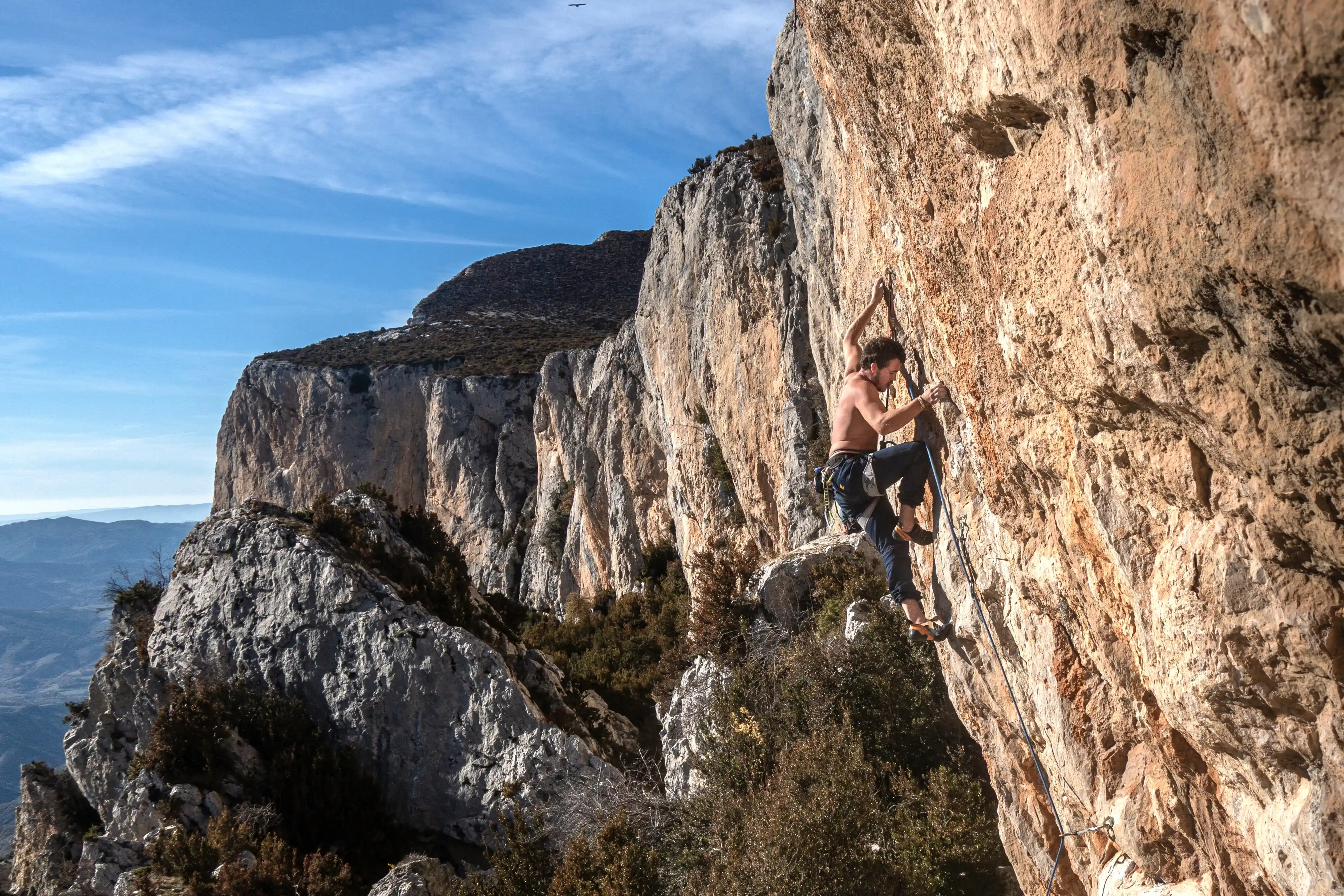
© Photo by Adri Martínez
Why Northern Catalonia Belongs on Every Serious Climber's List
The case for this region at a European level comes down to a few things that, taken together, are genuinely rare.
Scale. Most sport climbing areas in Europe, no matter how good, are essentially collections of single-pitch routes with a few longer options. Northern Catalonia has walls of 400–500 metres that are accessible within a morning's drive from a major city. The Congost de Mont-rebei alone contains more genuinely big limestone in a single gorge than most climbers will encounter in a lifetime of European travel.
Density. Within a forty-kilometre radius, you have Montrebei, Terradets, Àger, Sant Llorenç, Camarasa, Vilanova de Meià, and half a dozen other crags. The Lleida Climbs guidebook covers 22 separate areas and nearly 3,900 routes from F3 to F9. A dedicated two-week climbing trip would still leave the region feeling unfinished.
Quality at every grade. This is not just an area for the elite or just an area for beginners. The multi-pitch terrain at Montrebei and Vilanova de Meià requires genuine alpine-style competence. The sport climbing at Àger and Terradets rewards grades in the F7s. The middle-grade multi-pitch at Sant Llorenç and Terradets is ideal for progressing climbers. Santa Linya offers routes that very few people in the world can climb. The full spectrum is covered.
Year-round climbing. The south-facing orientation of most walls and the sheltered pre-Pyrenean position means that climbing happens here through every month of the year. January in the Congost de Mont-rebei, with the gorge mist low on the river and the rock cold and biting in the shade of the wall, is not a compromise. It is an experience.
Wildness. Perhaps most importantly, this region has retained something that most of Europe's famous limestone destinations have lost: the feeling of being somewhere genuinely off the map. There are no queues. There are no vendors at the base of the crag. There are bearded vultures, golden eagles, and griffon vultures. There are old shepherd's paths and semi-ruined farmhouses. The natural park of the Montsec, the protected zone of the Congost, and the general neglect that comes from not being on the tourist trail have combined to preserve a landscape that feels, improbably, like the climbing equivalent of a library that no one else knows about.
Practical Information for Visiting Climbers
Getting there: Fly to Barcelona or Lleida-Alguaire airport. Lleida is the closest major city to the core areas. From Barcelona, plan two hours to Montrebei or Terradets, 90 minutes to Sant Llorenç or Camarasa. A rental car is essential — there is no practical public transport to the crags.
When to go: October–November and March–May are the best months for most multi-pitch objectives. Àger and Sant Llorenç work well throughout winter. Camarasa is excellent in summer. August on the main south-facing walls is survivable only with very early starts.
Where to stay: Balaguer makes a good central base. Smaller villages such as Àger itself, Sant Llorenç de Montgai, or the campsite near Terradets reservoir place you closer to the rock. Airbnb options exist in the larger villages.
Guidebooks: Lleida Climbs (P. O'Donovan / D. Andrada, 3rd edition 2019) is the essential reference — nearly 3,900 routes across 22 zones in English, Spanish, and Catalan. Montrebei (L. Alfonso) covers the big gorge in detail. Montsec Oeste (available via Climb Europe) covers the multi-pitch terrain around Àger, Canelles, and El Doll.
Gear: For sport and short multi-pitch, a standard 60-metre rope and a dozen quickdraws will cover most situations. For Montrebei and serious Montsec routes, add a full rack or two of cams and nuts, a couple of 60-metre double ropes, and all the self-rescue equipment you would take to the Alps. These routes are in the mountains. Treat them accordingly.
Guides: Our Certified mountain guides (AEGM) from KooKoo Climb operate throughout the region and can take you onto routes that would otherwise be inaccessible or dangerous for self-guided teams. For first visits to Montrebei or Vilanova de Meià in particular, a guide's knowledge of the terrain, the descents, and the weather makes a significant practical difference.
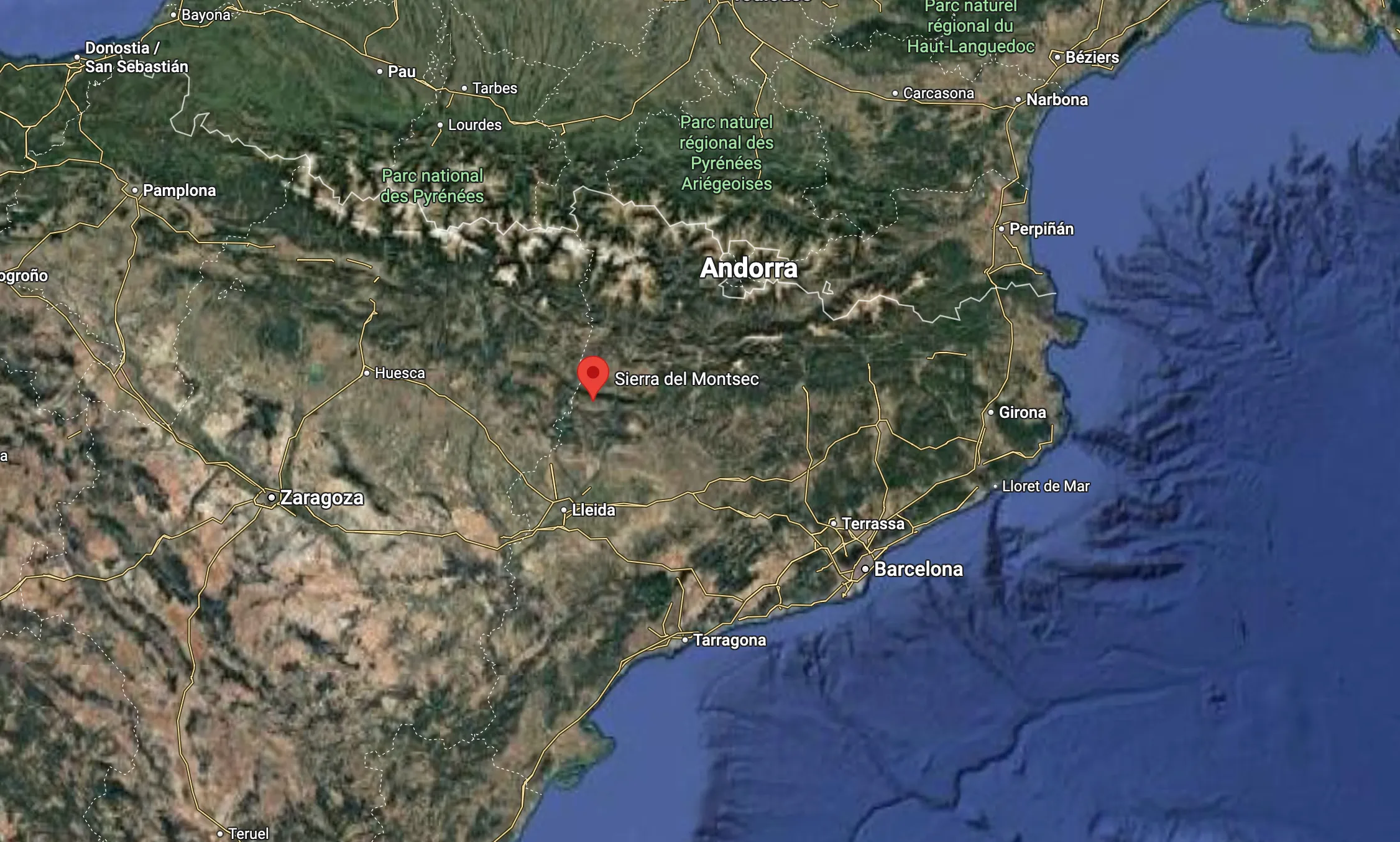
Serra del Montsec Location
The Region Through the Eyes of Someone Who Has Spent Time Here
There is something specific about the Pre-Pyrenean light in late October. It comes in low and golden across the Lleida plain, hitting the limestone walls at an angle that makes every hold look like it has been carved by hand. The air smells of rosemary and dust. The days are short enough to keep you focused but long enough for a full multi-pitch objective. And at the end of the day, driving back through the almond groves toward the lights of whatever village you have chosen as a base, there is a particular satisfaction that comes from having climbed something real — something that demanded attention, commitment, and skill, in a landscape that asked nothing of you except that you show up prepared.
Northern Catalonia will not be a secret forever. The Lleida climbing community has been building it quietly for forty years, and it has already attracted the world's best climbers to its harder sport routes. The multi-pitch terrain and the big walls are the next chapter.
For now, the gorge is quiet. The vulture is still in the sky. The route is still waiting.
Check our guided options in the area by clicking here.
This article focuses on the Montsec range and the Lleida Pre-Pyrenees climbing corridor. All grade references use the French sport climbing scale (F) and the UIAA scale for traditional routes (V, V+, VI, etc.).