

How Difficult Is Mont Blanc? An Honest Answer From Mountain Guides
How hard is Mont Blanc really? Grade, fitness required, technical skills, success rates and the sections that turn climbers back — explained by professional guides.
 by Xavi Coll
·
Fri 3 Jul 2026
by Xavi Coll
·
Fri 3 Jul 2026
Mont Blanc is graded PD ("Peu Difficile" moderately difficult) on the alpine grading scale, which misleads thousands of climbers every year. On paper, that's one of the easier grades in alpinism. In practice, the highest mountain in Western Europe defeats between a quarter and a third of the people who attempt it, and the ones it turns back are rarely stopped by anything technical. They're stopped by altitude, by weather, and by a level of sustained physical effort that almost nobody trains for properly.
So here is the honest answer, the one we give our own clients at KooKoo Climb before they book: Mont Blanc is not a technical climb, but it is a genuinely hard mountain. If you can comfortably hike 1,400 metres of ascent with a 10 kg pack and you commit to a proper preparation block, it is absolutely achievable for a fit hillwalker with no previous mountaineering experience — provided you climb with a guide and give the mountain the respect it demands. If you show up undertrained, it will find you out before the Goûter hut.
Let's break down exactly where the difficulty lies.
The numbers: what "difficult" looks like on Mont Blanc
The summit stands at roughly 4,810 metres, and the standard Goûter Route involves around 2,400 metres of total ascent from the Nid d'Aigle railhead at 2,372 m, typically split over two or three days. Summit day alone — from the Goûter Refuge at 3,835 m to the top and back — runs 8 to 12 hours of continuous effort at an altitude where your body is operating on roughly 55–60% of the oxygen available at sea level.
The mountain sees an estimated 20,000–25,000 summit attempts per year across all routes. Success rates for well-prepared guided groups sit around 75–85% in stable weather. For independent, unguided parties, published figures are less reliable, but every guide who works the massif will tell you the same thing: the failure rate among unguided climbers is dramatically higher, and the accident statistics — the Mont Blanc massif averages over a hundred fatalities a year across all its routes and activities — are dominated by parties who underestimated the mountain.
Those numbers are worth sitting with. Mont Blanc kills more people annually than Everest, not because it is harder, but because its reputation as "the easy 4,800er" invites people who have no business being above 4,000 metres in crampons.
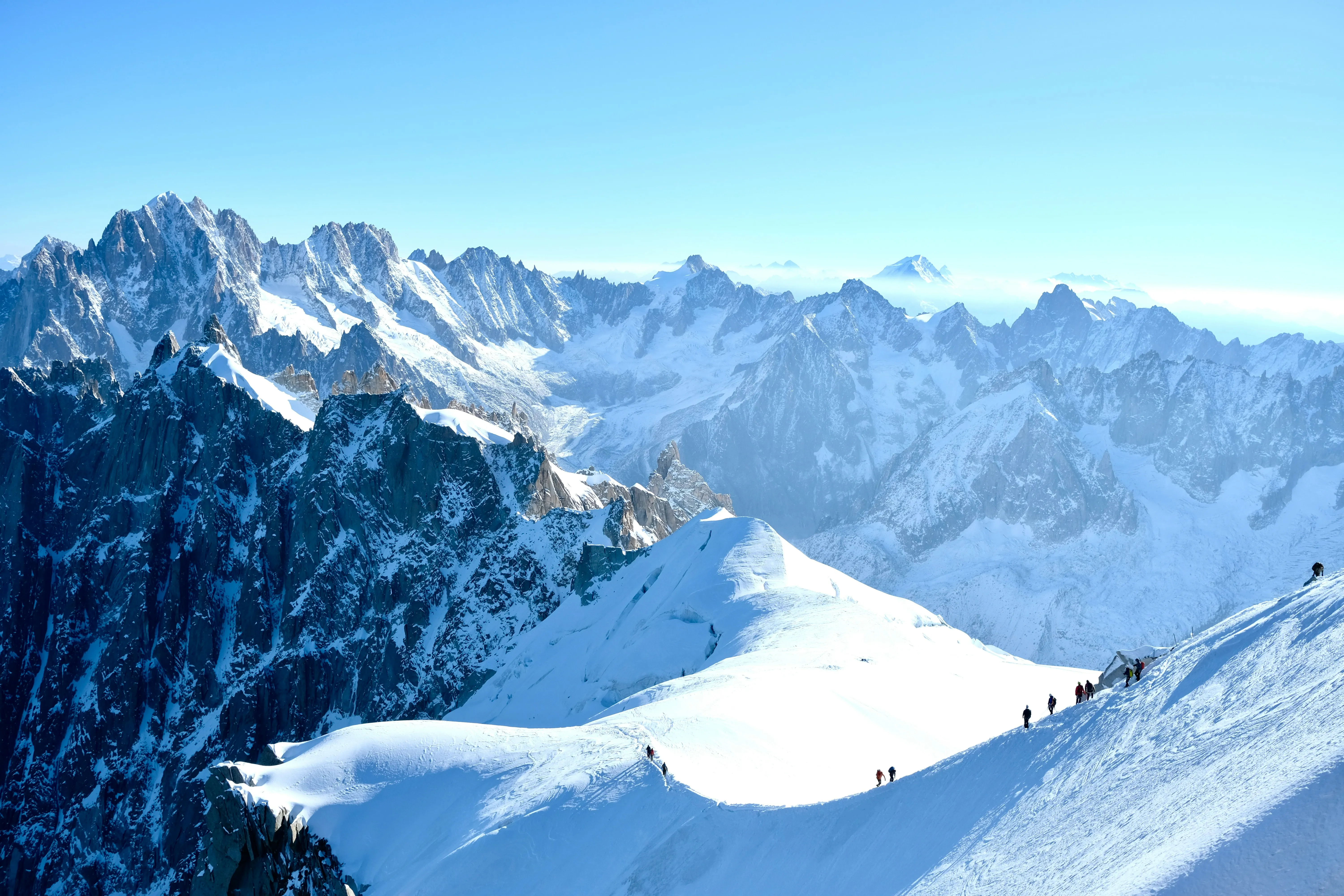
The Aiguille du Midi Ridge
What the PD grade actually means, and what it doesn't
The alpine grading system (F, PD, AD, D, TD, ED) measures technical difficulty: how hard the actual climbing moves are, how steep the ice is, how exposed the terrain gets. By that yardstick, the Goûter Route is honest PD. There is no vertical climbing. The scrambling on the Aiguille du Goûter is straightforward with hands out of pockets. The Bosses Ridge to the summit is a walk — a spectacular, airy, sometimes knife-edged walk, but a walk.
What the grade does not measure:
- Altitude. Nothing in the PD grade tells you what it feels like to put one foot in front of the other at 4,700 m at four in the morning, at minus fifteen degrees, on hour seven of your summit day. This is where most attempts actually end.
- Duration and commitment. A PD rock route in the valley might take two hours. Mont Blanc's PD is spread over 8–12 hour days, back to back, with poor sleep at altitude in between.
- Objective hazard. The Grand Couloir — the stone-swept gully that must be crossed below the Goûter hut — is statistically the most dangerous few hundred metres in the Alps. The crossing itself takes under a minute; the exposure to rockfall is real and cannot be eliminated, only managed with timing, helmets and quick movement.
- Weather. Mont Blanc generates its own weather. Winds on the Bosses Ridge regularly exceed anything a hillwalker has experienced, and the summit dome offers zero shelter. A forecast that looks acceptable in the valley can be unclimbable up high.
This is why experienced guides describe Mont Blanc as "a serious mountain with easy climbing" — and why the grade alone should never be the basis of your decision to attempt it.
The four sections that decide your summit
1. Nid d'Aigle to Tête Rousse (2,372 m → 3,167 m)
The warm-up: around 800 m of ascent on rocky trail and easy moraine, taking most parties 2.5–3.5 hours. If this stage feels hard, that is important information. Guides quietly watch clients on this section, because anyone struggling here has effectively no chance higher up. It should feel comfortable.
2. The Grand Couloir and the Goûter scramble (3,167 m → 3,835 m)
The crux of the route in terms of hazard and, for many, in terms of terror. First the couloir crossing — fast, focused, helmet on, one at a time, ideally in the cold hours when the stonefall is quietest. Then roughly 600 vertical metres of scrambling up the Aiguille du Goûter ridge, protected in places by fixed cables. None of it is technically hard, but it is sustained, exposed in sections, and frequently done in crampons when icy. Tired climbers make mistakes here, and this is where a rope and a guide earn their keep. Budget 2–3 hours.
3. The Dôme du Goûter (3,835 m → 4,304 m)
Summit day begins in the dark, usually between 2 and 4 a.m. The long, moderate snow slopes of the Dôme are physically simple and psychologically brutal: a two-hour treadmill of cramponing at altitude where the effects of thin air become unmistakable. Pacing discipline here — slow, steady, no stops longer than a few minutes — is what separates parties that summit from parties that blow up.
4. The Bosses Ridge (4,362 m → 4,810 m)
Past the Vallot emergency shelter, the route narrows onto the famous Bosses Ridge: two humps of snow and then a final, beautiful, exposed crest to the summit. Technically it remains easy. But you are now above 4,500 m, the wind is usually working on you, the drops on either side concentrate the mind, and every step costs double what it did at the hut. This final 90 minutes to 2 hours is where the mountain collects its debts from anyone who skipped training days back home.
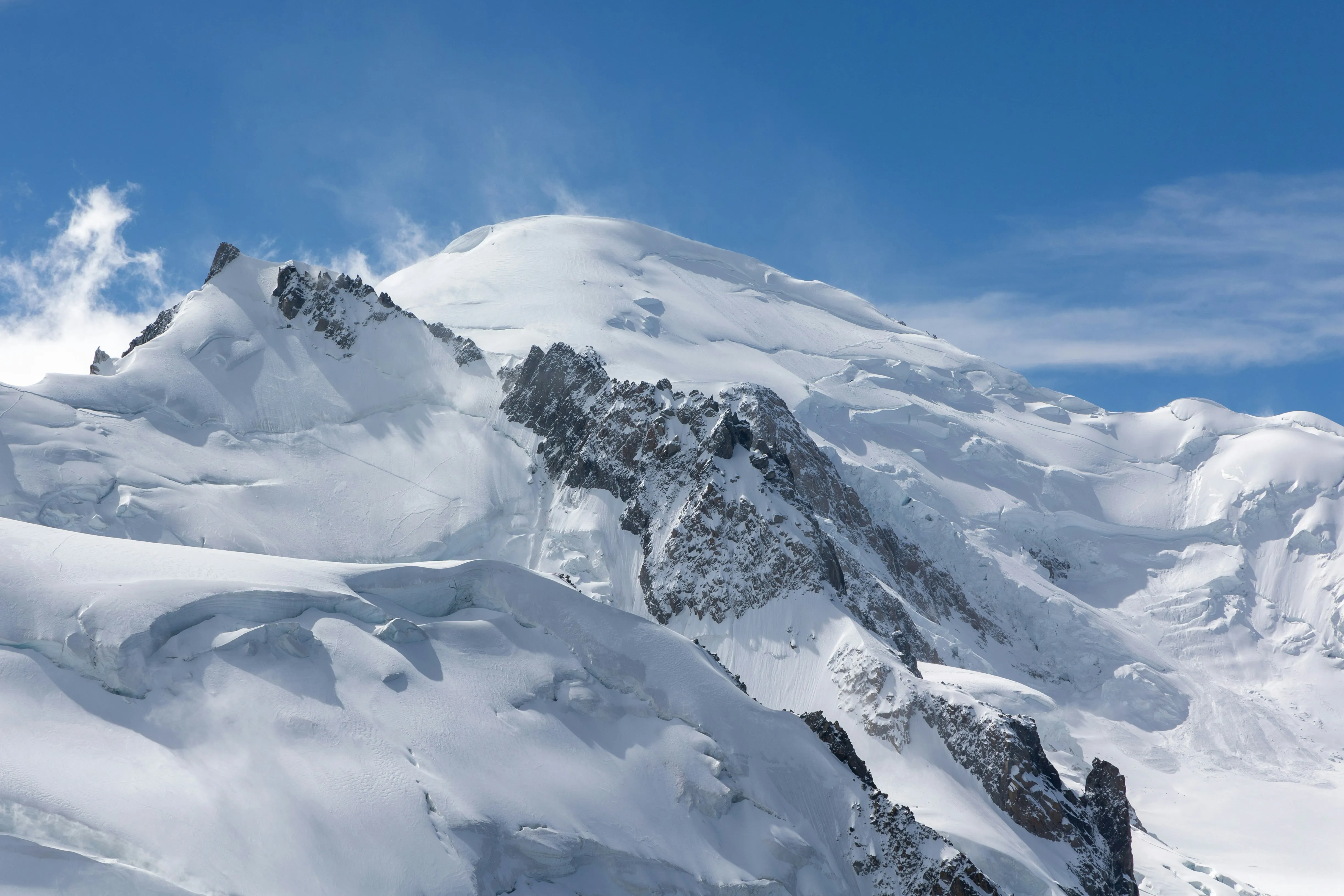
Majestic Mont Blanc
How fit do you actually need to be?
Forget vague advice about "good general fitness." Here is a concrete benchmark we use with our own Mont Blanc clients: you should be able to complete a mountain day of 1,200–1,500 m of ascent, carrying 8–10 kg, in under 4.5 hours, and feel that you could do it again the next day. If you can do that comfortably, you have the engine for Mont Blanc. If you can't yet, you need a structured 12–16 week preparation block — we cover exactly how to build one in our Mont Blanc training plan.
Also, if you plan to do our 3-DAY PROGRAM, you must have previous experience using crampons and touring ice axe on alpine / glacier terrains. Mont Blanc is not a hike, but an alpine climb. Some people underestimate it.
If you prefer or if you don't have that experience, you can join our 5-DAY PROGRAM, which includes 2 days for acclimatization and training, plus the climb to Mont Blanc itself in 3 days.
Technical skills: what you must know vs what you'll be taught
On a guided ascent, the technical entry bar is low by design. You need to be sure-footed on rough, exposed ground — the kind of confidence built by scrambling in the Scottish Highlands, the Pyrenees or the Dolomites. Everything else — walking in crampons, using an ice axe, moving on a rope as part of a team — is taught and rehearsed during the acclimatisation phase before summit day. This, if you do the 5-day program.
For unguided parties the bar is entirely different: solid crampon technique on hard snow and ice, crevasse rescue skills, navigation in whiteout, the judgement to read the Grand Couloir and the weather, and enough alpine experience to turn around when the mountain says no. If you have to ask whether you're ready to climb Mont Blanc unguided, you are not, and that's not gatekeeping, it's what the rescue statistics say.
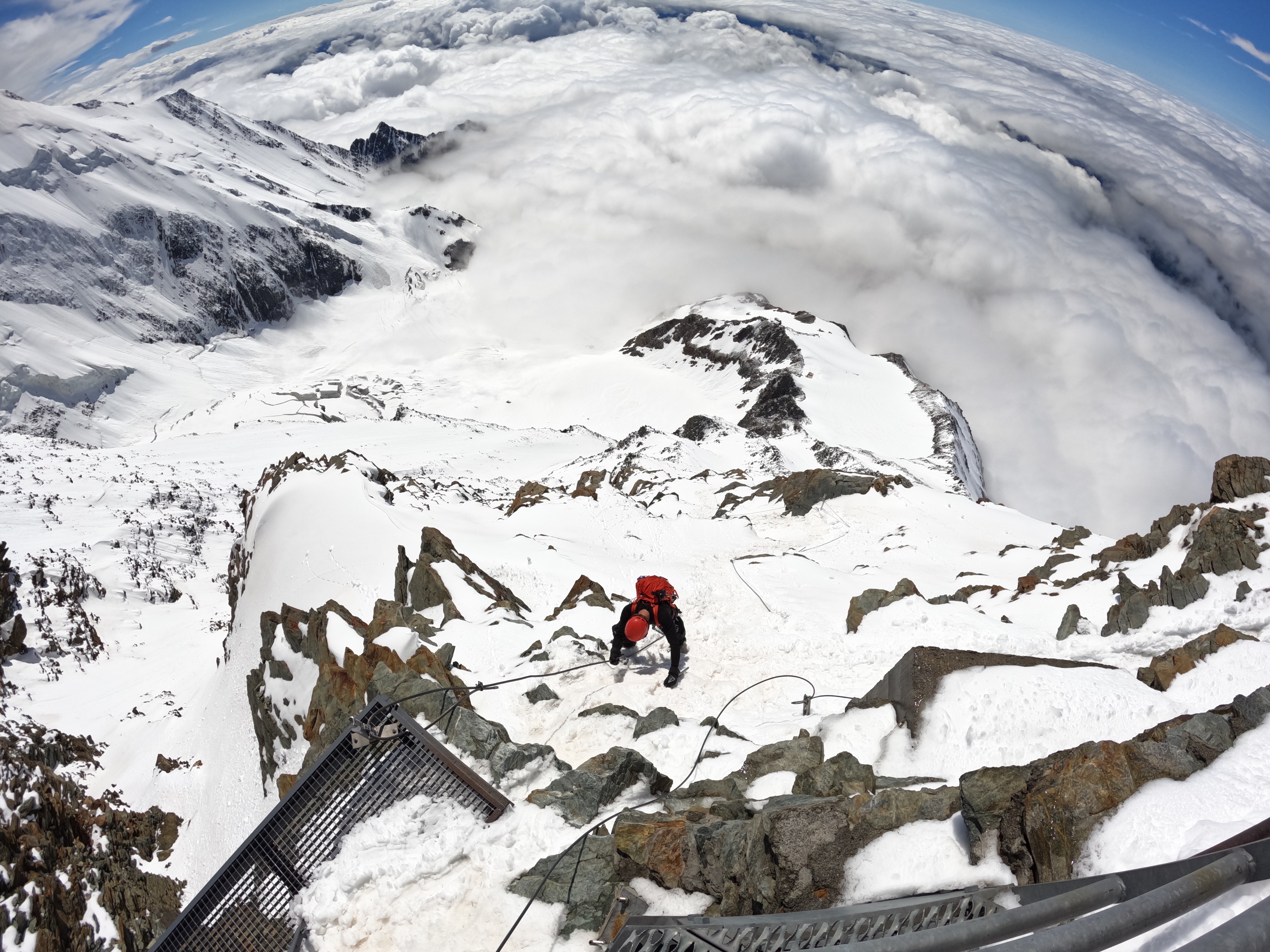
Climbing from Tête Rousse to Goûter
Altitude: the invisible difficulty
Above 3,500 m, unacclimatized bodies may begin to protest: headaches, nausea, broken sleep, a dramatic drop in output. Mont Blanc's particular trap is that its infrastructure lets you get high fast — valley to 3,835 m in a single day is entirely possible, and entirely inadvisable. Acute mountain sickness ends more summit bids than the Grand Couloir ever will.
The fix is structural: build real acclimatisation into the itinerary. That's why serious programmes — ours included — run 4–6 days rather than a minimal 2-day hit, using a 3,000–4,000 m training peak before the main ascent. The difference in summit-day performance between an acclimatised and unacclimatised climber at 4,600 m is not subtle. It is the difference between climbing and surviving.
The logistical difficulty nobody warns you about
Since a prefectural decree, huts on the normal route — Tête Rousse and the Goûter Refuge — operate under a mandatory named-reservation system: no booking, no bed, and no bed effectively means no legal ascent, because camping and bivouacking are banned by ministerial decree across the entire protected Mont Blanc site. Enforcement is real.
The refuges open in late May and close in early October, and prime July–August dates routinely sell out within hours of the booking window opening in spring. Guided operators hold block bookings, which is one of the less obvious but most practical reasons to climb with a company: the hut problem is solved for you. Independent climbers who start planning in June for a July attempt will almost certainly find the door closed.
So, can you climb Mont Blanc?
Strip away the mystique and the answer is usually clear:
Yes, realistically, if: you're a fit, regular hillwalker; have some experience on winter / alpine terrains, you can commit to 12+ weeks of specific training; you're comfortable on exposed scrambling terrain; you'll climb with a certified guide; and you can be flexible enough with dates to respect the weather.
Not yet, if: your longest recent mountain day is a distant memory; exposure genuinely frightens you rather than focuses you; or your plan involves squeezing the ascent into a fixed 48-hour window regardless of forecast. The mountain doesn't negotiate, and the best guides won't either.
Mont Blanc's difficulty is honest once you understand where it lives: not in the moves, but in the altitude, the length of the days, the objective hazards and the weather. Prepare for those four things specifically, and the "difficult" mountain becomes what it should be — one of the great achievable adventures in world mountaineering, and very possibly the finest summit day of your life.
At KooKoo Climb we run small-group guided Mont Blanc ascents built around proper acclimatization, honest fitness screening and IFMGA-certified guiding, because we'd rather turn you into a climber who summits than a client who merely attempts.
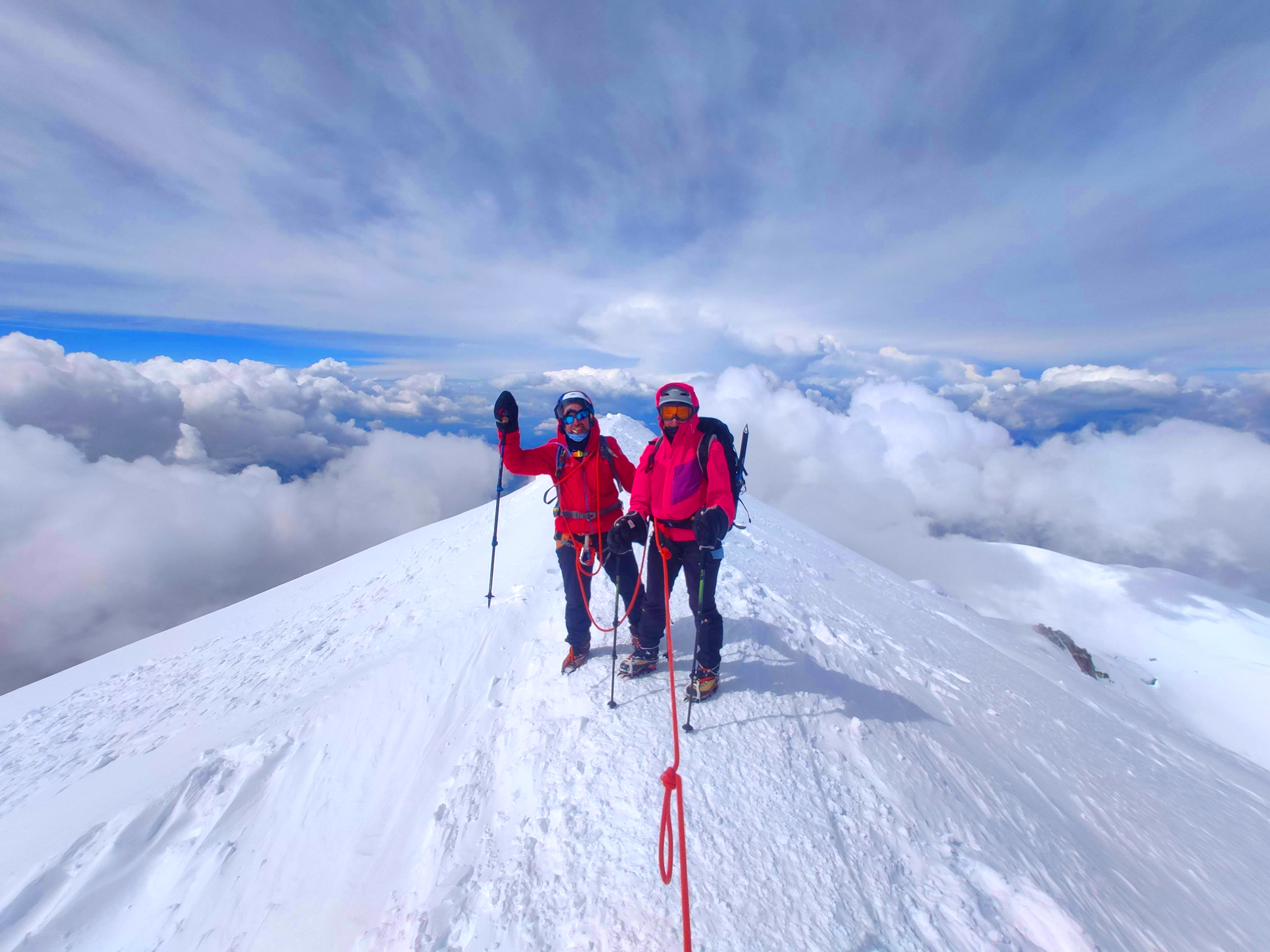
Mont Blanc summit at 4,810m
Frequently asked questions
Is Mont Blanc harder than Kilimanjaro?
Technically, yes. Kilimanjaro is a high-altitude trek with no snow skills required; Mont Blanc demands crampons, an ice axe, exposed scrambling and glacier travel. Kilimanjaro is higher (5,895 m), so the altitude challenge is greater there, but the overall mountaineering difficulty of Mont Blanc is a clear step up.
Can a beginner climb Mont Blanc?
A fit beginner with no alpine experience, but extended hiking experience can summit Mont Blanc on a properly structured guided program that includes training and acclimatization days. A beginner should not attempt it unguided under any circumstances.
What is the hardest part of Mont Blanc?
Statistically, the Grand Couloir crossing is the most hazardous section due to rockfall. Physically, the final push above 4,300 m on the Bosses Ridge is where most climbers reach their limit, as altitude and accumulated fatigue converge.
How long does it take to climb Mont Blanc?
The minimum is 3 days via the Goûter Route, but 4–6 day programs with built-in acclimatization and preparation on nearby mountains have significantly higher success rates and are what most professional operators recommend.
Do you need a permit to climb Mont Blanc?
There is no summit permit, but reservations at the refuges on the normal route are mandatory under prefectural regulation, and camping is banned across the protected site. So in practice, a confirmed hut booking functions as your ticket to climb.
What is Mont Blanc's success rate?
Well-prepared guided groups summit at roughly 75–85% in stable conditions. Overall success across all attempts is lower, with weather and inadequate acclimatization being the two most common reasons for failure.